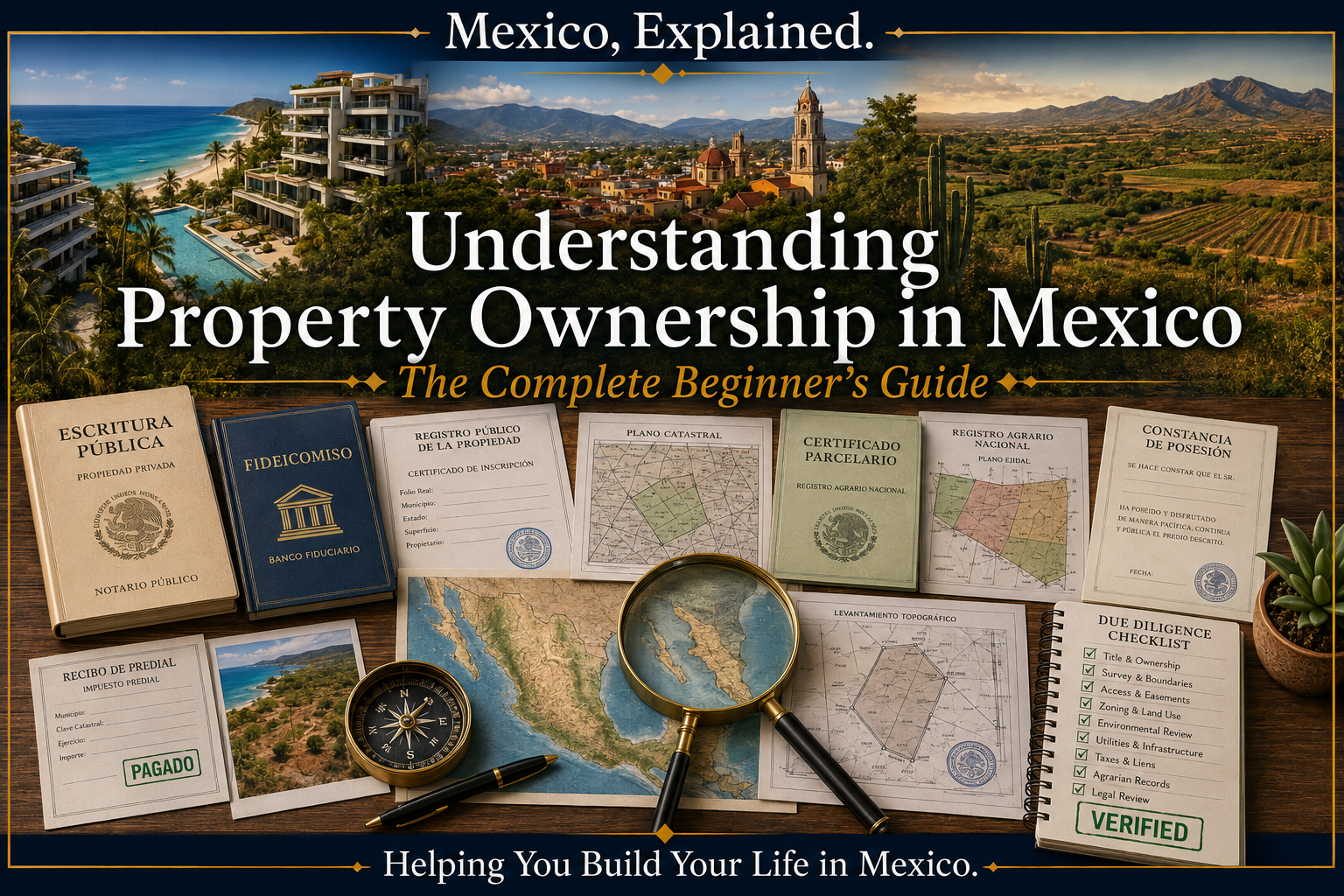
Understanding Property Ownership in Mexico: A Beginner's Guide
Private Property, Fideicomisos, Ejidos, Communal Land, Possession Rights and the Professionals Who Help Protect Your Purchase
By Andy & Christine | eXp Realty México
If you're considering buying property in Mexico, you've probably already encountered unfamiliar terminology.
Escritura.
Fideicomiso.
Notario Público.
Ejido.
Bienes Comunales.
Posesión.
Registro Público.
Registro Agrario Nacional.
And after reading enough articles and social media posts, you may be left wondering:
“How does property ownership actually work in Mexico?”
That's exactly what this guide is designed to answer.
The first thing international buyers should understand is that there isn't one single category called “Mexican property.”
Mexico has different forms of land tenure and different legal structures through which rights to property may be held.
Understanding which one you're dealing with is one of the most important steps you can take before purchasing.
So let's start from the beginning.
Yes, Foreigners Can Buy Property in Mexico
Let's clear up one of the biggest misconceptions first.
Foreigners can acquire real estate in Mexico.
The structure used depends partly on where the property is located and how it will be used.
Mexico's Constitution establishes what is commonly called the restricted zone: land within 100 kilometers of an international border and 50 kilometers of the coastline. Foreign individuals can directly own land outside that zone, subject to applicable Mexican requirements; residential acquisitions by foreigners within the restricted zone are commonly structured through a bank trust known as a fideicomiso.
This distinction is particularly important in destinations such as Mexico's coastal markets.
But before discussing how a foreigner acquires a property, we need to answer something even more fundamental:
What kind of property is it?
The Big Picture: Property in Mexico Is Not All the Same
For a beginner, it helps to think about Mexican real estate as several different legal landscapes.
You may encounter:
Private Property — Propiedad Privada
Conventional privately held real estate.
Ejido Property
Land governed by Mexico's agrarian legal system.
Bienes Comunales
Communally held land governed by agrarian law and community structures.
Possession-Based Situations
Situations where someone exercises or documents possession of land but may not hold conventional registered private title.
These concepts can overlap with complicated histories, regularization processes and conversions.
But they should never automatically be treated as interchangeable.
Let's examine them individually.
1. What Is Private Property in Mexico?
For many foreign buyers, this is the form of property ownership most similar conceptually to what they're accustomed to at home.
Privately owned real estate is generally documented through an escritura pública and registered through the appropriate property registry.
The escritura contains important information about the property and transaction.
Depending on the situation, it may identify matters such as:
The owner
Property description
Surface area
Boundaries
How ownership was acquired
Applicable transaction information
Other legal characteristics
When privately titled property is sold, the transaction typically involves a Mexican Notario Público.
And that's where another major misunderstanding begins.
2. A Mexican Notario Público Is Not a U.S. Notary Public
The titles sound almost identical.
Their roles are not.
A U.S. notary public generally performs limited functions involving identification, signatures and document authentication.
A Mexican Notario Público is a highly qualified legal professional entrusted by the state with important public legal functions.
In real estate transactions, the Notario plays a central role in legally formalizing qualifying property transfers.
We've written an entire article about this because the distinction is so important:
Notary Public in the U.S. vs. Notario Público in Mexico
And later in this ownership series:
Why the Right Notary and Legal Team Matter More Than You Think
The key lesson is simple:
Don't translate the title and assume the job is the same.
It isn't.
3. What Is an Escritura Pública?
Buyers often use the English word “deed.”
In Mexico, you'll frequently hear escritura pública.
For conventional private-property transactions, this is one of the central documents associated with formal ownership.
But buyers should understand an important principle:
Having an escritura doesn't mean you should skip due diligence.
Professionals may still need to investigate:
Ownership
Registration
Liens or encumbrances
Taxes
Boundaries
Easements
Land use
Construction documentation
Seller authority
Other matters affecting the property
A document doesn't eliminate the need to understand what the document says.
4. What Is the Registro Público de la Propiedad?
For private property, the appropriate Public Registry of Property plays an important role in the legal framework surrounding registered real estate.
Registration allows relevant acts affecting real property to be recorded and investigated.
This is distinct from another registry you'll encounter later:
The Registro Agrario Nacional.
That distinction is extremely important.
Think of it broadly like this:
Private-property matters → Public Property Registry
Ejido and communal/social-property matters → Registro Agrario Nacional
The actual analysis of any particular property can be more nuanced, but this distinction helps beginners understand why different land types can involve different documentation and institutions.
5. What Is a Fideicomiso?
This is one of the most misunderstood concepts among foreign buyers.
A fideicomiso is a bank trust structure commonly used when a foreign buyer acquires residential property within Mexico's restricted zone.
The Mexican bank acts as trustee, while the foreign buyer is the beneficiary and receives the rights of use and enjoyment established through the trust structure. Mexican law requires authorization from the Secretaría de Relaciones Exteriores for these restricted-zone real-estate trusts involving foreign beneficiaries.
This means foreigners can acquire residential interests in beautiful coastal destinations through a legally recognized structure.
But here's the concept buyers sometimes miss:
A fideicomiso is not a substitute for good title.
Putting a property into a trust doesn't magically correct problems with the underlying land.
You still need to understand the legal status of the property itself.
6. What Is Ejido Land?
Now we enter a very different area of Mexican property law.
Ejidos form part of Mexico's system of propiedad social, or social/agrarian property.
Ejido land is governed by Mexico's agrarian legal framework rather than simply functioning like conventional privately titled real estate.
Individual ejidatarios may hold recognized rights associated with parcels, but those rights should not automatically be confused with privately registered ownership.
The distinction matters enormously when someone markets land by saying:
“It's ejido now, but you can get a deed later.”
Maybe there is a legitimate legal process available.
But buyers should never assume that future conversion is automatic.
We explain this extensively in:
Ejidos vs. Bienes Comunales: What's the Difference?
and:
How Land Becomes Private Property in Mexico
7. What Is Dominio Pleno?
You'll frequently hear the term dominio pleno when discussing certain ejido parcels transitioning into private property.
This isn't simply someone deciding:
“My land is private now.”
There are legal procedures involved.
The applicable requirements depend on the status of the land and actions taken within the agrarian framework.
That's why a buyer shouldn't rely solely on statements such as:
“Dominio pleno is almost finished.”
Instead, ask:
What stage is it actually in?
What has been approved?
What has been registered?
What remains outstanding?
What documentation proves that?
Current status matters more than future promises.
8. What Are Bienes Comunales?
Bienes Comunales are another form of social property.
They are frequently grouped together with ejidos in casual conversation, but they're not simply another word for ejido.
Communal property has its own legal and historical characteristics and involves collectively recognized rights.
This matters because buyers sometimes encounter land advertised informally without understanding the underlying legal regime.
If the property is communal, that fact needs to be understood before treating the transaction like a conventional private-property purchase.
9. What Is the Registro Agrario Nacional?
When agrarian property enters the conversation, another institution becomes extremely important:
Registro Agrario Nacional — RAN
The RAN is responsible for controlling and documenting aspects of ejido and communal land tenure and providing documentary legal certainty derived from Mexico's Agrarian Law. It performs registral, cadastral and documentary functions relating to social property.
Its records can include acts that create, modify or extinguish agrarian rights, along with organizational, technical and other agrarian information.
For certain properties, understanding the RAN records can be essential.
That's why we dedicated an entire article to a subject rarely explained clearly in English:
Understanding the Mexican Agrarian Registry (RAN)
10. What Are Possession Rights?
This is where buyers need to become especially careful with terminology.
Someone may possess land.
They may:
Occupy it
Farm it
Maintain it
Fence it
Build on it
Pay certain local charges
Have utilities
Hold documents recognizing possession
But:
Possession does not automatically equal privately registered ownership.
Depending on the circumstances, possession may be supported by documentation such as:
Constancias de posesión
Contracts
Tax records
Cadastral information
Surveys
Community documentation
Historical records
Other evidence
Those documents can matter.
But the question isn't merely:
“Does the seller have paperwork?”
It's:
“What legal rights does that paperwork establish?”
We explore this in:
Understanding Possession Rights in Mexico
11. Can You Buy Land Without an Escritura?
This is where things become interesting.
You may encounter transactions involving rights or possession where the buyer does not receive a conventional private-property escritura.
Does that automatically mean the transaction is fraudulent?
No.
Does it mean it's equivalent to buying privately titled property?
Also no.
That's precisely why we created:
Can You Really Buy Land Without a Deed in Mexico?
The article explores possession, private title, ejido rights, communal property, risk and opportunity.
The fundamental principle is:
Before deciding whether something is a good investment, determine exactly what legal right is being offered.
12. A Cadastral Record Is Not Automatically a Title
This is another common source of confusion.
A property may have:
A cadastral number
Municipal records
Predial receipts
Maps
Utility accounts
Those records can be important.
But buyers shouldn't automatically interpret them as proof of privately registered ownership.
Different government systems record different information for different purposes.
This is why due diligence means looking at the entire legal and documentary picture.
13. Paying Property Taxes Doesn't Automatically Make Someone the Owner
You'll sometimes hear:
“The seller has paid predial for 20 years.”
That's useful information.
But it doesn't answer every ownership question.
Property-tax receipts can form part of the property's documentary history.
They shouldn't, by themselves, replace an investigation of title or legal rights.
The same principle applies to electricity or water bills.
They can demonstrate a relationship with the property.
They don't automatically prove private ownership.
14. How Do You Know What You're Actually Buying?
This is where due diligence becomes essential.
Due diligence may involve investigating:
Title
Ownership history
Seller identity
Seller authority
Liens
Encumbrances
Property taxes
Utilities
HOA obligations
Surveys
Boundaries
Easements
Legal access
Zoning
Land use
Environmental restrictions
Building permits
Agrarian records, when applicable
The investigation depends on the property.
A condominium in a completed private development doesn't necessarily require exactly the same investigation as undeveloped rural land with an agrarian history.
That's why due diligence should be property-specific.
Read:
What Due Diligence Really Means When Buying Property in Mexico
15. Who Protects the Buyer?
Foreign buyers sometimes ask:
“Isn't the Notario my attorney?”
Not exactly.
Different professionals perform different functions.
Your Real Estate Advisor
Helps identify property, negotiate, coordinate documentation and communication, track the transaction, and connect the appropriate professionals.
The Notario Público
Performs the public legal functions required to formalize qualifying property transactions.
An Independent Attorney
When appropriate, provides legal advice focused specifically on the client's interests.
Surveyors and Technical Professionals
May verify boundaries, measurements and physical characteristics.
Tax Professionals
Advise on individual tax consequences.
Banks and Trustees
May participate when a fideicomiso is required.
The strongest transactions often aren't about finding one person who knows everything.
They're about assembling the right professionals for the situation.
16. What About Condominiums?
Many foreign buyers purchase condos rather than land or standalone homes.
A condominium introduces another layer of documentation and obligations.
Buyers may need to understand:
Condominium regime
HOA rules
Monthly fees
Special assessments
Common areas
Parking rights
Storage rights
Rental restrictions
Internal regulations
Outstanding HOA balances
Insurance arrangements
The individual unit may be privately owned while certain areas are held or administered in common according to the condominium regime.
This is why buyers shouldn't review only the unit.
They should understand the condominium structure they're buying into.
17. What About Pre-Construction Property?
Pre-construction requires a different type of due diligence.
You're not simply evaluating what exists today.
You're evaluating what someone promises to deliver tomorrow.
That may require reviewing matters such as:
Developer
Land ownership
Permits
Project documentation
Purchase contract
Payment schedule
Delivery obligations
Cancellation provisions
Amenities
Construction specifications
Consumer-protection requirements
This is also where NOM-247-SE-2021 and PROFECO can become particularly relevant in qualifying residential real-estate transactions.
We've created separate guides explaining both.
18. Why NOM-247 Matters
Mexico has consumer-protection rules specifically affecting certain residential real-estate activities.
NOM-247 addresses commercial practices and information requirements in residential real-estate transactions involving suppliers covered by the standard.
For foreign buyers accustomed to a different regulatory environment, understanding that Mexico has formal consumer-protection requirements can be reassuring.
But regulations don't replace due diligence.
They form another layer of protection within the transaction.
Read our complete guide:
Understanding NOM-247: What Property Buyers in Mexico Should Know
19. What Is PROFECO?
PROFECO is Mexico's federal consumer-protection authority.
Its role extends far beyond real estate, but consumer-protection rules can become relevant when dealing with businesses and suppliers in the property sector.
We've written a separate guide explaining:
What Is PROFECO and How Does It Protect Homebuyers in Mexico?
This is especially valuable for foreign buyers who may not realize what consumer-protection infrastructure exists in Mexico.
20. Ownership Is Only One Part of the Question
A property can have valid private title and still be unsuitable for what you want to do with it.
Suppose you buy beautiful land intending to build six vacation rentals.
You still need to investigate:
Zoning
Density
Land use
Environmental restrictions
Building permits
Legal access
Water
Electricity
Wastewater
Infrastructure
This is why:
“Can I own it?”
and:
“Can I do what I want with it?”
are two different questions.
Both matter.
21. The Restricted Zone Doesn't Mean Foreigners Can't Own Coastal Property
This myth deserves repeating because it's so persistent.
The restricted zone does not mean foreign buyers are prohibited from acquiring residential interests in coastal property.
Instead, the law provides a trust mechanism through which qualifying foreign buyers can use and enjoy residential property in the zone. Official Mexican guidance describes the restricted zone as 100 km from international borders and 50 km from the coastline and explains the fideicomiso structure for foreign residential buyers.
That's why foreigners routinely acquire homes and condominiums in Mexico's coastal destinations.
The structure is different.
The opportunity is very real.
22. The Most Important Question Isn't “Is It Safe?”
Buyers naturally ask:
“Is buying property in Mexico safe?”
But that's almost too broad to be useful.
A better series of questions is:
What property am I buying?
What is its current legal status?
Who owns or holds the rights?
What documentation proves that?
What legal structure applies to me?
What restrictions affect the property?
Who has independently reviewed the transaction?
That's how you move from generalized fear—or generalized confidence—to actual information.
23. Common Property-Ownership Myths
Let's summarize some of the biggest misconceptions.
“Foreigners can't own property in Mexico.”
False as a general statement. Foreigners can acquire Mexican real estate, although the structure differs in the restricted zone.
“If I pay predial, I own the property.”
Not necessarily.
“A cadastral number proves title.”
Not necessarily.
“Possession and ownership are the same.”
Not automatically.
“Ejido means you can never obtain private property.”
Too simplistic. Certain agrarian procedures can alter the legal status of qualifying parcels, but the current status and completed legal steps must be verified.
“A fideicomiso means the bank owns my house and can take it whenever it wants.”
That's a misleading characterization of the trust structure. The bank serves as fiduciary while the beneficiary receives rights of use and enjoyment established under the trust and applicable law.
“If there's an escritura, there's nothing else to investigate.”
Incorrect.
“If there's no escritura, it must be a scam.”
Also too simplistic.
The recurring theme is:
Investigate before assuming.
24. The Beginner's Property Ownership Checklist
Before purchasing property in Mexico, you should ultimately understand:
What type of property is this?
What is its current legal status?
Who legally owns or holds the rights?
What documentation supports those rights?
Can those rights legally be transferred?
Is the property private, ejidal, communal, possession-based, or something requiring further investigation?
What registry or government records are relevant?
Are the boundaries and surface area correct?
Are liens or encumbrances present?
Is legal access established?
What zoning and land-use restrictions apply?
Are environmental restrictions relevant?
What foreign-ownership structure applies?
What taxes, HOA fees or other obligations exist?
What professionals should review the transaction?
What exactly will I legally acquire at closing?
If you don't know the answer to one of these questions, don't panic.
It simply means:
There's another question to investigate.
The Complete Mexico Property Ownership Series
This cornerstone guide gives you the big picture.
Now you can go deeper into the subject that applies to your particular property.
Article 1
Ejidos vs. Bienes Comunales: What's the Difference?
Understand two important forms of Mexican social property and why they shouldn't be confused.
Article 2
How Land Becomes Private Property in Mexico
Learn about private property, agrarian history, dominio pleno and why legal status must be verified.
Article 3
What Due Diligence Really Means When Buying Property in Mexico
Explore what professionals may investigate before you purchase.
Article 4
Understanding the Mexican Agrarian Registry (RAN)
Learn why this federal institution can become extremely important when agrarian property is involved. The RAN itself describes its mission as providing documentary legal certainty for ejido and communal property through registration, document preservation, and technical and cadastral functions.
Article 5
Why the Right Notary and Legal Team Matter More Than You Think
Understand the different professionals involved in a Mexican property transaction.
Article 6
Can You Really Buy Land Without a Deed in Mexico?
Understand the distinction between private title and other rights connected to land.
Article 7
Understanding Possession Rights in Mexico
Learn why possession and ownership aren't automatically synonymous.
Article 8
The Biggest Mistakes Buyers Make When Purchasing Land in Mexico
Discover common mistakes involving documentation, boundaries, zoning, environmental restrictions and legal review.
Article 9
The Complete Guide to Buying Land in Mexico
Follow the entire buyer journey—from finding land through due diligence and closing.
And together, these articles answer one much larger question:
How do I make an informed property decision in Mexico?
The Mexico, Explained. Philosophy
There's a reason we've created this series.
Buying property in another country can feel intimidating when every document, institution and legal term is unfamiliar.
But unfamiliar doesn't automatically mean unsafe.
And complicated doesn't automatically mean bad.
The answer isn't fear.
It's education.
We believe buyers should understand:
What they're buying.
How they're buying it.
Who is responsible for each part of the transaction.
What questions still need answers.
And ultimately:
What they will legally own or have the right to use when the transaction is complete.
Final Thoughts
Property ownership in Mexico isn't impossible to understand.
You simply have to stop trying to translate every concept directly into the system you know back home.
Mexico has its own legal framework.
Its own institutions.
Its own history.
Its own terminology.
And its own processes for private property, agrarian land and foreign ownership.
Once you understand those distinctions, the process becomes much clearer.
You don't need to become a Mexican real-estate lawyer.
You don't need to become an expert in agrarian law.
And you don't need to understand every article of every statute.
You need to know which questions to ask—and which professionals should answer them.
Because the goal isn't simply to buy property in Mexico.
It's to understand what you're buying before you buy it.
Thinking About Buying Property in Mexico?
Whether you're considering a beachfront condominium, retirement home, investment property, development opportunity or piece of land, understanding the property's legal status is one of the most important parts of the process.
Our role is to help buyers ask better questions, coordinate with the appropriate professionals and navigate the process with greater clarity.
Andy & Christine
eXp Realty México
Helping You Build Your Life in Mexico—One Informed Decision at a Time.