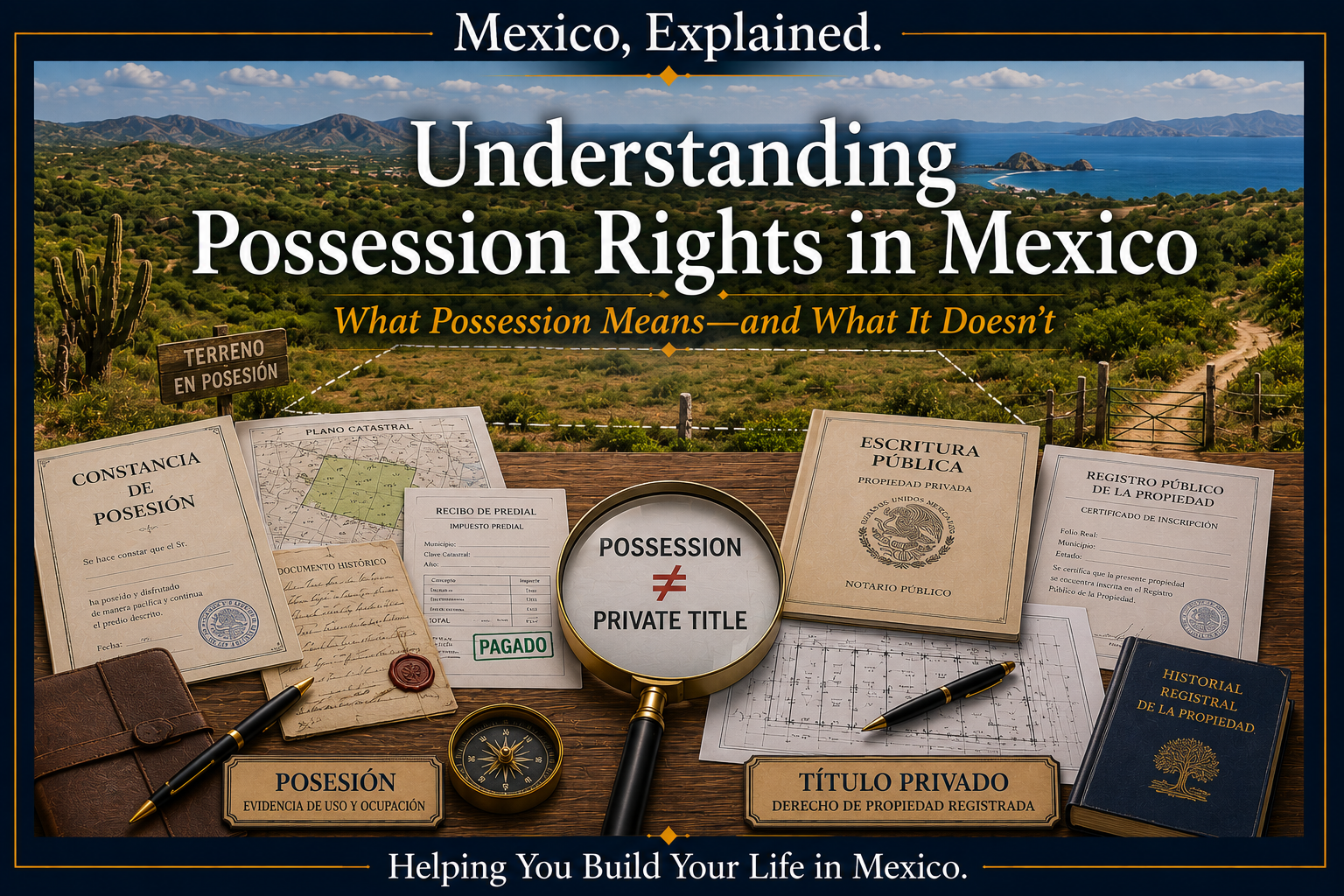
Understanding Possession Rights in Mexico
What Possession Means, What It Doesn't Mean, and Why Buyers Need to Know the Difference
By Andy & Christine | eXp Realty México
When searching for land or property in Mexico, you may eventually encounter a listing described with phrases such as:
“Derechos de posesión.”
“Constancia de posesión.”
“Property sold through possession rights.”
For international buyers, these terms can be confusing.
Does possession mean ownership?
Can possession rights be sold?
If someone has occupied a property for 20 years, does that make them the legal owner?
And perhaps the most important question:
If I purchase possession rights, what exactly am I buying?
There is no responsible one-size-fits-all answer.
The word possession can describe an important factual and legal relationship with land, but it should never automatically be treated as synonymous with privately titled ownership.
Understanding that distinction can completely change how you evaluate a property.
What Does Possession Mean?
At its simplest, possession refers to a person exercising control or use over property.
Someone might:
occupy the land,
live on it,
cultivate it,
maintain it,
fence it,
build on it,
or otherwise exercise control over it.
But the fact that someone possesses property does not, by itself, answer a different question:
Who legally owns the property?
That's where buyers need to be careful.
Possession and ownership are related concepts, but they are not automatically the same thing.
Possession Is Not Automatically Private Ownership
Imagine someone has lived on a parcel of land for many years.
They have maintained it.
They have paid certain local charges.
Perhaps electricity is in their name.
They may even have documents acknowledging their possession.
Those facts can be important.
But they should not automatically be interpreted as evidence that the person holds a privately registered title to the property.
Private ownership normally involves a different legal and documentary framework.
That is why asking:
“Does the seller have documents?”
isn't enough.
The better question is:
“What legal rights do those documents actually establish?”
What Does Private Ownership Look Like?
With conventional privately owned real estate in Mexico, ownership is generally formalized through an escritura pública and registration with the appropriate Registro Público de la Propiedad.
That framework allows professionals to investigate matters such as:
registered ownership,
ownership history,
liens and encumbrances,
legal description,
seller authority,
and other matters affecting the property.
Possession documentation may tell a different story.
It can provide evidence relating to the occupation or use of the land without necessarily establishing the same type of privately registered ownership.
That difference matters enormously when buying.
What Documents Can Support Possession?
Depending on the property's circumstances, someone claiming possession may have documents such as:
A constancia de posesión
Private agreements or contracts
Cadastral records
Property tax receipts
Utility bills
Surveys or plans
Community records
Historical possession documents
Municipal documentation
Agrarian documentation, where applicable
Documents relating to improvements or construction
These documents can be valuable evidence.
But buyers should resist a common mistake:
A collection of documents isn't automatically the equivalent of an escritura.
Each document needs to be understood within its proper legal context.
What About Property Taxes?
This deserves special attention because it causes considerable confusion.
A seller may say:
“I've paid predial for years, so I'm the owner.”
Property tax records can certainly form part of the property's documentary history.
But a predial receipt should not, by itself, be treated as definitive proof of private ownership.
The same applies to cadastral records.
Being listed in a municipal system and holding registered private title are not necessarily the same thing.
And Utility Bills?
The same principle applies.
Electricity, water, internet, or other accounts in someone's name can help demonstrate a relationship with a property.
They may support evidence of occupation.
But they do not automatically establish privately titled ownership.
Think of these documents as pieces of evidence rather than automatic proof of title.
What About a Constancia de Posesión?
The phrase sounds official—and depending on who issued it and under what circumstances, the document may be important.
But buyers should ask:
Who issued the constancia?
Under what authority?
What exactly does it certify?
What property does it describe?
Does the description match the physical land?
Does it recognize possession, ownership, or another right?
Are there other people with competing rights?
Can the rights recognized by the document legally be transferred?
The title of a document tells you very little without understanding its legal effect.
Possession Can Exist Under Different Legal Frameworks
This is another reason the subject is complicated.
Possession can arise in very different circumstances.
A property may involve:
Private property with incomplete or complicated documentation.
Ejido land governed by agrarian law.
Bienes Comunales governed by communal and agrarian structures.
Unregularized land where ownership or boundaries require clarification.
Or another legal situation entirely.
Simply hearing the word posesión does not tell you which situation you're dealing with.
You need to investigate further.
Possession Rights and Ejido Rights Are Not Automatically the Same Thing
This is another misconception worth addressing.
People sometimes use informal terminology loosely when discussing rural land.
But ejido rights have their own legal framework.
An ejidatario may hold recognized agrarian rights, and specific parcels may be documented through Mexico's agrarian system.
Those rights should not simply be reduced to the phrase “possession rights.”
Likewise, an informal possession claim should not automatically be interpreted as an ejido right.
Terminology matters.
Documentation matters even more.
Long-Term Possession Doesn't Automatically Answer the Ownership Question
Buyers sometimes hear:
“The family has had this property for 40 years.”
That history can be extremely relevant.
But duration alone shouldn't end the investigation.
Instead, it should lead to additional questions:
How did the family originally acquire the land?
What documents exist?
Has anyone else claimed rights over it?
How are the boundaries established?
Under what legal regime does the property fall?
Is there registered title?
If not, what rights actually exist today?
History provides context.
Due diligence determines what that history means legally.
Can Possession Ever Become Ownership?
Under certain circumstances, Mexican law provides mechanisms through which possession and other forms of land rights may eventually lead to or become associated with recognized ownership.
But the applicable procedure depends heavily on the circumstances.
The property's history, legal classification, location, documentation, type of possession, applicable laws, and rights of third parties can all matter.
This is precisely why buyers should be skeptical of statements such as:
“Just buy it now and get the deed later.”
Maybe there is a legitimate legal path.
Maybe there isn't.
The important point is to establish that before investing—not afterward.
Why Would Anyone Buy Possession Rights?
This is where the conversation becomes more nuanced.
Properties involving possession can sometimes offer opportunities.
They may be:
More affordable
Located in emerging areas
Available in larger parcels
Situated in beautiful rural locations
Connected to areas where formalization is evolving
Attractive to buyers comfortable with greater complexity
That doesn't automatically make them bad investments.
But the lower price may sometimes reflect greater uncertainty or reduced legal certainty compared with privately titled property.
Risk and opportunity often exist together.
What Could Go Wrong?
Potential risks vary considerably, but they can include:
Competing Claims
Someone else may claim ownership, possession, inheritance rights, or another interest in the land.
Boundary Disputes
The land being physically shown to you may not correspond exactly with the documentation.
Problems With Access
A beautiful parcel isn't very useful if the legal right of access is uncertain.
Difficulty Obtaining Permits
Construction, land use, environmental regulations, or municipal requirements may create complications.
Difficulty Reselling
Your future buyer may not accept the same legal structure or level of risk.
Limited Financing
Traditional lenders may require forms of legal security unavailable in some possession transactions.
Failure to Obtain Future Title
Perhaps the biggest danger is buying based on the assumption that private title will eventually be obtained when no reliable legal basis supports that expectation.
Foreign Buyers Should Be Particularly Careful
International buyers face an additional challenge.
They may be unfamiliar with Mexican property terminology and assume concepts work the same way they do in Canada or the United States.
They don't.
A foreign buyer should also remember that rules concerning foreign ownership—particularly within Mexico's constitutionally restricted zone—can add another layer to the transaction.
A fideicomiso, for example, should not be confused with a mechanism for converting possession into private title.
The underlying property's legal status must first be understood.
Questions to Ask Before Considering a Possession Transaction
Before investing, you should be able to obtain meaningful answers to questions such as:
Who currently possesses the property?
Who legally owns the underlying land, if different?
What documents support the seller's rights?
How were those rights acquired?
Are the rights legally transferable?
Are there competing claims?
Does the physical parcel match the documentation?
Is legal access established?
What land-use restrictions apply?
Are agrarian records involved?
Is there a legitimate path toward private title?
What exactly will the buyer receive at closing?
And one of the most important:
Who has independently verified these answers?
When Professional Advice Becomes Essential
Possession transactions are precisely the type of situation where buyers should avoid relying solely on:
The seller
The seller's representative
Neighbors
Local custom
Verbal assurances
Social media
Or what happened with another property nearby
A qualified professional needs to evaluate the specific property and specific documents involved.
Depending on the circumstances, that may include:
A Mexican real estate attorney
A Notario Público
Agrarian-law counsel
A surveyor
Municipal authorities
The Registro Agrario Nacional
Other appropriate specialists
Your real estate advisor can help coordinate that process, but shouldn't substitute their opinion for specialized legal advice.
“Everyone Here Buys Like This” Isn't Due Diligence
This phrase deserves its own section because buyers hear it frequently.
Local experience matters.
Community history matters.
Understanding how transactions have traditionally occurred in an area can provide valuable context.
But none of that replaces verifying your particular property.
The fact that ten other people accepted a certain arrangement doesn't establish what legal rights you will receive.
Real estate due diligence should always move from:
“This is how people say it works.”
to:
“This is what the documentation and applicable legal framework establish.”
The Objective Isn't to Eliminate Every Risk
No real estate investment anywhere in the world is completely without risk.
The objective is to identify the risks you can identify, understand them, and decide whether they are acceptable to you.
One buyer may be comfortable purchasing a property involving possession rights after extensive professional review.
Another may decide they only want privately titled real estate.
Both decisions can be reasonable.
What's dangerous is making either decision without understanding the difference.
Final Thoughts
Possession rights in Mexico aren't inherently good or bad.
They're simply not the same thing as privately titled ownership.
Possession can be supported by meaningful documentation.
It can have a long history.
It can sometimes represent an interesting opportunity.
But it can also involve uncertainty that needs to be carefully evaluated.
So before asking:
“Is possession safe?”
Ask something more useful:
“What exactly does this possession give me the legal right to do, and what does it not give me?”
That's where informed decision-making begins.
Because the goal isn't simply to acquire land.
It's to understand exactly what you're acquiring.
Continue Exploring the Series
This article follows Can You Really Buy Land Without a Deed in Mexico? and builds on our earlier guides to Ejidos, Bienes Comunales, Dominio Pleno, Due Diligence, the Registro Agrario Nacional, and the role of the Notario Público and legal team.
Coming Next
The Biggest Mistakes Buyers Make When Purchasing Land in Mexico
We'll examine why low prices, verbal promises, incomplete documentation, unclear boundaries, zoning assumptions, and skipping professional review can turn an exciting opportunity into an expensive lesson.
Thinking About Buying Land in Mexico?
Whether you're evaluating private property, possession rights, rural land, or property with an agrarian history, the first objective should be understanding its current legal status.
The beautiful view comes with the land.
Confidence comes from knowing what you're buying.
Andy & Christine
eXp Realty México
Helping You Build Your Life in Mexico—One Informed Decision at a Time.