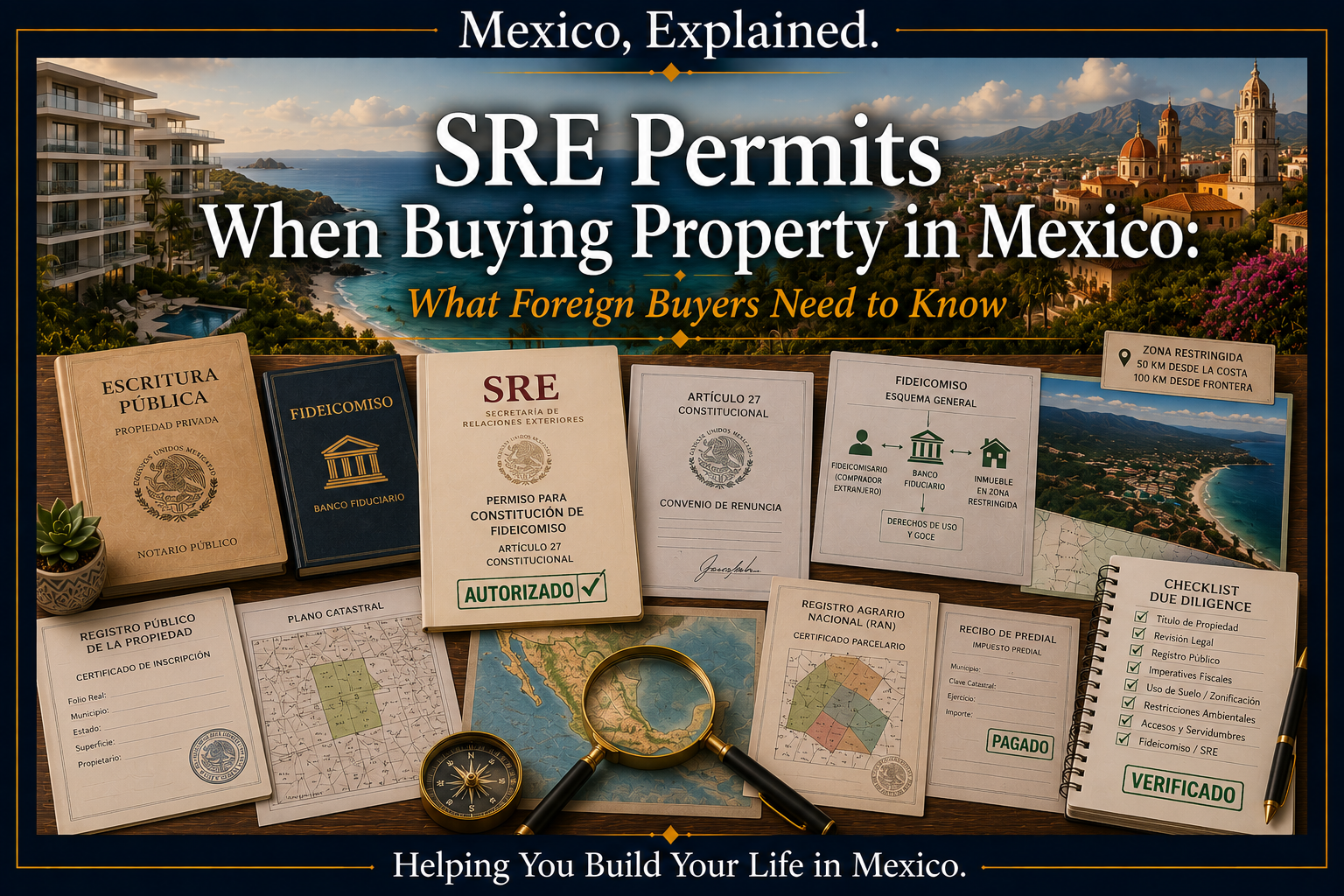
SRE Permits When Buying Property in Mexico: What Foreign Buyers Need to Know
Mexico, Explained.
SRE Permits When Buying Property in Mexico: What Foreign Buyers Need to Know
Why Mexico's Foreign Affairs Ministry May Be Part of Your Real Estate Transaction
By Andy & Christine | eXp Realty México
You've found the property.
You've negotiated the price.
Your offer has been accepted.
You've started gathering documents for the Notario.
And then someone tells you:
“We need the SRE permit.”
For many foreign buyers, the immediate reaction is:
“Why does Mexico's Ministry of Foreign Affairs have anything to do with buying my house?”
It's a very reasonable question.
The Secretaría de Relaciones Exteriores (SRE)—Mexico's Ministry of Foreign Affairs—plays an important role in certain real estate acquisitions involving foreign buyers.
But here's where confusion often begins:
Not every foreign buyer follows exactly the same SRE process.
The procedure depends largely on where the property is located and how the property will be held.
Let's break it down.
First: What Is the SRE?
SRE stands for:
Secretaría de Relaciones Exteriores
In English, it is generally referred to as Mexico's Ministry of Foreign Affairs or Foreign Affairs Secretariat.
Most people associate the SRE with passports, embassies, international relations and Mexican nationality.
But the SRE also has responsibilities connected to Article 27 of the Mexican Constitution, foreign investment and certain acquisitions of Mexican real estate by foreigners.
That is why the SRE may become part of your property transaction.
Why Does Article 27 Matter?
Article 27 of the Mexican Constitution establishes an important principle regarding foreign ownership of Mexican real estate.
Foreigners may acquire property in Mexico subject to Mexican law, but constitutional rules create an important distinction involving what is known as the:
Restricted Zone — Zona Restringida
The restricted zone generally includes land located within:
100 kilometers of Mexico's international borders
and
50 kilometers of Mexico's coastline.
This distinction is extremely important because it affects how a foreign buyer may acquire rights in the property.
Scenario 1: Buying Property Outside the Restricted Zone
Let's say you're a foreign buyer purchasing a home in a location outside Mexico's restricted zone.
In that situation, a foreign individual may generally acquire direct ownership of qualifying private property, subject to the applicable legal requirements.
But there is an important constitutional step.
The foreign buyer must enter into the agreement commonly referred to as the:
Convenio de Renuncia
This derives from Article 27, Section I of the Mexican Constitution.
In simplified terms, the foreign buyer agrees to consider themselves Mexican with respect to the property and not invoke the protection of their foreign government regarding that property.
This is sometimes referred to as the Calvo Clause.
It does not mean you're giving up your nationality.
It relates specifically to your rights concerning the property.
What Does the SRE Do in This Situation?
For an acquisition outside the restricted zone, the foreign buyer must complete the applicable SRE procedure associated with this constitutional agreement.
As of 2026, the SRE requires information that can include:
Buyer's name and nationality
Immigration status
Immigration-document information
Property description and location
Method of acquisition
Percentage being acquired
Surface area
Measurements
Boundaries and adjoining properties
The buyer must also demonstrate an immigration status that permits the acquisition.
When there is uncertainty about whether a property falls inside or outside the restricted zone, the SRE may consult INEGI, and geographic or UTM coordinates may be requested.
The important lesson for buyers is:
The SRE requirement should be identified early in the transaction—not discovered at the closing table.
Scenario 2: Buying Residential Property Inside the Restricted Zone
Now imagine you're buying a home near the beach.
Perhaps in:
Zihuatanejo.
Ixtapa.
Puerto Vallarta.
Los Cabos.
Cancún.
Tulum.
Riviera Maya.
Or another Mexican coastal destination.
Because these locations are generally within 50 kilometers of the coastline, a foreign individual cannot simply acquire direct ownership of residential land there in the same manner as qualifying property outside the restricted zone.
Instead, residential property is commonly acquired through a:
Fideicomiso
A fideicomiso is a Mexican bank trust.
The bank acts as the fiduciario, or trustee, while the foreign buyer becomes the fideicomisario, or beneficiary.
The trust gives the beneficiary rights to use and enjoy the property under the trust structure, subject to its terms and Mexican law.
And this is where the SRE enters the transaction again.
The SRE Permit for a Fideicomiso
Before the bank can establish the applicable real-estate trust in the restricted zone, an SRE permit is required for the constitution of the fideicomiso.
This is an important distinction.
The foreign buyer isn't simply applying for permission to “own a house on the beach.”
The SRE authorization permits the Mexican financial institution to establish the trust through which the foreign beneficiary will hold the applicable rights to the property.
The SRE currently requires information including:
Name and nationality of the person establishing the trust
Name of the Mexican bank serving as trustee
Name and nationality of the beneficiary
Substitute beneficiaries, when applicable
Duration of the trust
Intended use of the property
Description and location
Surface area
Measurements and boundaries
Distance from the international border or Federal Maritime-Terrestrial Zone
The application for this type of SRE authorization is currently submitted electronically through the government's SIPAC27 system.
How Long Can a Fideicomiso Last?
An SRE-authorized real-estate fideicomiso in the restricted zone may have a duration of up to:
50 years
This sometimes scares buyers when they first hear it.
They think:
“Does that mean I lose the property after 50 years?”
That is not the right way to understand the structure.
Mexican law provides mechanisms for extending the duration of these trusts, subject to the applicable requirements and authorization.
So the 50-year period should not automatically be interpreted as an expiration date after which the government simply takes the property.
Who Actually Requests the SRE Permit?
This is another question buyers frequently ask.
In a fideicomiso transaction, buyers usually don't personally navigate the entire SRE application process themselves.
The process is generally coordinated through the professionals handling the transaction, particularly the fiduciary bank and Notario, depending on the transaction.
The buyer still needs to provide the requested personal information and documentation.
This is one reason choosing the bank, Notario and transaction team early can be important in a coastal purchase.
What Information Should Buyers Be Ready to Provide?
Exact requirements depend on the transaction, but foreign buyers should be prepared to provide documentation and information such as:
Full legal name
Nationality
Passport
Immigration documentation when applicable
Mexican immigration status
Address
Tax-identification information when required
Marital information when relevant
Details regarding how title or beneficial rights will be held
Substitute beneficiaries for a fideicomiso, when applicable
Your Notario, fiduciary institution or legal team should confirm the exact documentation required for your particular transaction.
Don't rely on an old checklist you found online.
Requirements and administrative procedures can change.
What Are Substitute Beneficiaries?
This is one of the advantages of understanding the fideicomiso before simply signing whatever appears in front of you.
When establishing the trust, buyers may be able to designate substitute beneficiaries.
These are the people who may receive the beneficial rights under the trust upon the beneficiary's death, subject to the terms of the fideicomiso and applicable law.
For many foreign buyers purchasing a retirement or family property in Mexico, this deserves careful consideration.
Don't wait until the closing appointment to ask:
“What happens to my property if something happens to me?”
Discuss succession planning while the trust is being structured.
Is an SRE Permit the Same as a Fideicomiso?
No.
This distinction is important.
The SRE Permit
Is the governmental authorization required for the bank to establish the applicable trust in the restricted zone.
The Fideicomiso
Is the actual bank trust through which the foreign beneficiary holds the rights to use and enjoy the property.
One is an authorization.
The other is the legal structure created using that authorization.
Is an SRE Permit Proof That the Property Has Good Title?
No.
And this may be the most important point in this entire article.
An SRE permit does not replace real estate due diligence.
It doesn't automatically prove:
The seller has good title
The property's measurements are correct
There are no liens
Taxes are current
Construction is properly documented
The seller has authority to sell
There are no boundary disputes
Zoning permits your intended use
Those questions belong to the broader due-diligence process.
An SRE authorization is one component of the transaction, not a substitute for investigating the property.
What Happens If the Property Is Ejido or Bienes Comunales?
This is where several concepts from our Mexico Property Ownership Explained series come together.
An SRE permit does not magically convert agrarian land into private property.
If the property is:
Ejido
Bienes Comunales
Subject to possession rights
In a regularization process
Awaiting dominio pleno
Otherwise not conventional private property
then the property's legal status needs to be understood first.
Only after determining what rights actually exist and whether they can legally be transferred should you determine what foreign-ownership structure may ultimately apply.
This is why buyers should never think:
“If SRE approves it, the property must be safe.”
These are separate legal questions.
Outside vs. Inside the Restricted Zone
Here's the easiest way for a foreign buyer to understand the distinction:
Outside the Restricted Zone
A foreign buyer may generally acquire qualifying private property directly, subject to the Article 27 constitutional agreement and applicable SRE procedure.
Inside the Restricted Zone — Residential Property
A foreign individual commonly acquires rights through a Mexican bank fideicomiso, for which SRE authorization is required.
This is why purchasing a home in central Mexico and purchasing a beachfront home can involve different ownership structures even though both buyers are foreigners.
What About Mexican Citizens?
The special foreign-acquisition rules discussed in this article concern foreign buyers.
A Mexican citizen purchasing qualifying private property does not require the same foreign-buyer SRE authorization merely because the property is near the coast.
That distinction can become relevant when couples or family members have different nationalities.
Ownership structure should therefore be discussed with the Notario and legal or tax professionals rather than chosen solely because one option appears administratively easier.
What If I'm a Permanent Resident of Mexico?
This is another common source of confusion.
Being a temporary or permanent resident of Mexico does not automatically make someone a Mexican citizen.
Nationality and immigration status are different concepts.
Therefore, a foreign national with Mexican residency should not automatically assume that the foreign-ownership rules no longer apply.
Your legal team should evaluate the buyer's nationality, immigration status, property location and intended ownership structure.
How Much Does the SRE Permit Cost?
Government fees can change, so buyers should always confirm the current amount rather than relying on an old article.
For 2026, the SRE currently lists the federal fee for issuance of a permit to establish a fideicomiso in the restricted zone at:
$21,650 MXN
The SRE also lists $5,250 MXN for the receipt, review and, when applicable, approval of the convenio de renuncia used by foreign individuals or entities acquiring property outside the restricted zone.
These are government SRE fees and should not be confused with:
Bank trust fees
Notarial fees
Acquisition taxes
Registration fees
Legal fees
Appraisal costs
Other closing expenses
When reviewing a closing estimate, ask what each charge actually represents.
How Long Does the SRE Process Take?
This is where buyers should avoid planning a closing around a generic number found online.
Processing times can depend on:
Type of SRE procedure
Completeness of the application
Property location
Whether geographic clarification is required
Fiduciary-bank processing
Notarial coordination
Administrative workload
Whether corrections are requested
For the current outside-the-restricted-zone procedure, the SRE specifically notes an approximate 20-business-day response period when it must consult INEGI because there is uncertainty over whether the property lies inside or outside the restricted zone.
For an actual purchase, your transaction team should confirm the expected timeline for your specific file.
A 2026 Update Buyers Should Know About
This is particularly important if you're reading older information online.
Mexico implemented simplification measures affecting several SRE Article 27 procedures in June 2026.
Among them, the SRE streamlined requirements for the permit used to establish fideicomisos in the restricted zone.
For that procedure, the current requirements are centered on:
The application through SIPAC27, and
Proof of payment of the applicable government fee.
The information about the parties, property, trustee bank, duration and intended use is incorporated into the electronic application.
This is a good example of why foreign buyers shouldn't assume a five-year-old blog post or checklist still reflects today's procedure.
A Simple Example
Imagine two Canadian buyers.
Buyer A purchases a home in central Mexico.
The property is outside the restricted zone.
Assuming it is qualifying private property and the other legal requirements are satisfied, the buyer may acquire direct ownership while completing the applicable Article 27/SRE requirements.
Buyer B purchases a residential villa near Mexico's Pacific Coast.
The property is within the restricted zone.
The foreign buyer commonly uses a bank fideicomiso, and the bank requires the applicable SRE authorization to establish that trust.
Both buyers can legally acquire property interests in Mexico.
They simply follow different legal structures.
The SRE Permit Is Only One Piece of the Puzzle
When buying property in Mexico, it's tempting to focus on a single document:
The escritura.
The SRE permit.
The fideicomiso.
The appraisal.
The tax certificate.
But a secure real estate transaction is rarely about one document.
It's about making sure all of the pieces fit together.
That includes:
The buyer.
The seller.
The property.
The ownership history.
The legal status.
The ownership structure.
The SRE requirements.
The Notario.
The fiduciary bank, when applicable.
And the due-diligence process.
Questions Foreign Buyers Should Ask Early
Before getting too far into a purchase, ask your professional team:
Is this property inside or outside Mexico's restricted zone?
What is the property's current legal status?
Can I acquire direct title, or will I need a fideicomiso?
Which SRE procedure applies to me?
Who will coordinate the SRE application?
What documentation do I need to provide?
When should the SRE process begin?
Could it affect our anticipated closing date?
What government fees apply?
If I'm using a fideicomiso, which bank will act as fiduciary?
Who should I designate as substitute beneficiaries?
Are there any unresolved property issues that need to be addressed before the ownership structure is finalized?
Those questions can prevent a great deal of confusion later.
Final Thoughts
The SRE requirement may initially sound like another complicated layer of buying property in Mexico.
But once you understand why it exists and where it fits into the transaction, it becomes much easier to navigate.
The most important distinction to remember is:
Foreign buyer + qualifying property outside the restricted zone → direct acquisition may be possible, with the applicable Article 27/SRE requirements.
Foreign buyer + residential property inside the restricted zone → a fideicomiso is commonly required, with SRE authorization for the trust.
And neither process replaces proper due diligence.
The objective isn't simply to obtain permission.
It's to make sure the property, ownership structure and documentation all work together correctly.
That's what turns a collection of legal documents into a well-structured real estate transaction.
Continue Exploring Mexico Property Ownership
This article is part of our Mexico Property Ownership Explained series.
If you're considering buying property in Mexico, continue with:
Understanding Property Ownership in Mexico: A Beginner's Guide
What Is a Fideicomiso? Understanding Coastal Property Ownership in Mexico
What Due Diligence Really Means When Buying Property in Mexico
Why the Right Notary and Legal Team Matter More Than You Think
Ejidos vs. Bienes Comunales: What's the Difference?
The Complete Guide to Buying Land in Mexico
Together, these guides are designed to help international buyers understand not simply what documents they need, but why they need them.
Thinking About Buying Property in Mexico?
Whether you're considering a coastal villa, condominium, retirement home, investment property or land, understanding the ownership structure should happen early in the buying process.
Our role is to help buyers ask the right questions, coordinate with the appropriate professionals and navigate the transaction with greater clarity.
Andy & Christine
eXp Realty México
Helping You Build Your Life in Mexico—One Informed Decision at a Time.