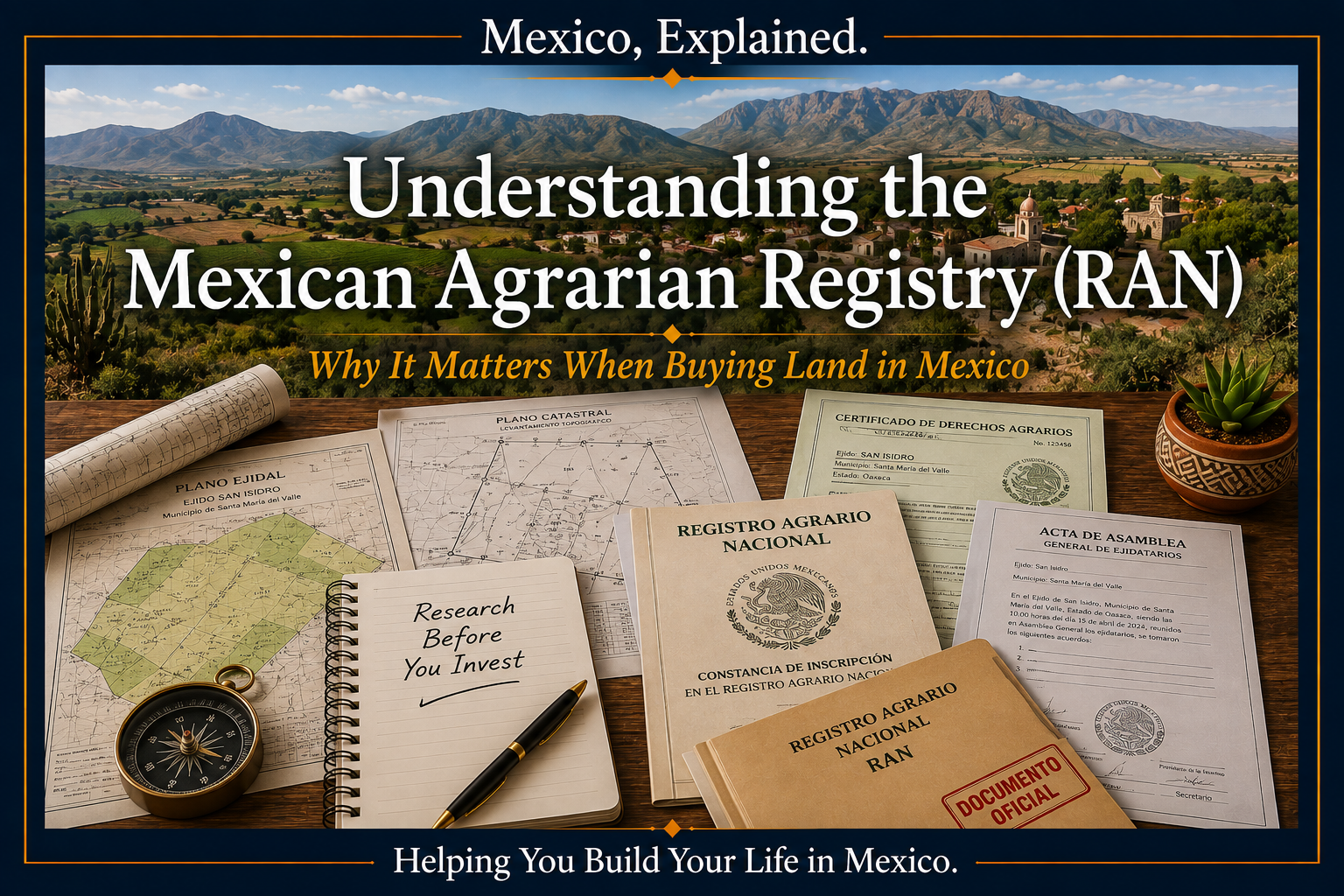
Understanding the Mexican Agrarian Registry (RAN)
What It Is, What It Does, and Why It Matters When Buying Land in Mexico
By Andy & Christine | eXp Realty México
If you've been researching land in Mexico, especially properties connected to Ejidos or Bienes Comunales, you've probably come across the term:
Registro Agrario Nacional, commonly known as the RAN.
For many buyers, this raises another question:
"What exactly is the RAN, and why does everyone keep mentioning it?"
It's an excellent question.
The RAN plays an important role in Mexico's agrarian system, yet very few foreign buyers understand what it actually does.
Let's simplify it.
What Is the Registro Agrario Nacional?
The Registro Agrario Nacional (RAN) is a federal institution responsible for maintaining official records related to Mexico's agrarian property system.
Its primary purpose is to document and administer information concerning Ejidos and Bienes Comunales, as established under Mexican agrarian law.
In simple terms:
The RAN maintains records about certain types of land that fall within Mexico's agrarian legal framework.
It is not the registry for every property in Mexico.
Is the RAN the Same as the Public Registry of Property?
No.
This is probably the biggest misunderstanding we encounter.
The Public Registry of Property generally records privately owned real estate and transactions affecting those properties.
The RAN, on the other hand, maintains records related to agrarian land.
Think of them as two different systems serving different legal purposes.
Understanding which registry applies to a property is an important part of due diligence.
What Information Does the RAN Maintain?
Depending on the property and its legal status, the RAN may maintain records such as:
Recognition of Ejidos and Bienes Comunales.
Community boundaries.
Rights held by ejidatarios or community members.
Assembly resolutions.
Agrarian certificates and related documentation.
Historical records concerning agrarian land.
The specific records available vary from one property to another.
When Should Buyers Be Interested in the RAN?
Not every buyer will need to consult the RAN.
However, it becomes especially relevant when a property:
has an agrarian history,
is associated with an Ejido,
involves Bienes Comunales,
or raises questions regarding agrarian rights.
If you're purchasing a typical condominium in a city, the RAN may not play a role in your transaction.
If you're buying rural land or property with an agrarian background, understanding the RAN can become much more important.
Why Does the RAN Matter?
One word:
Clarity.
Buying land isn't simply about beautiful views or attractive prices.
It's about understanding the property's legal history.
When applicable, RAN records help professionals verify information that forms part of the property's background.
That information contributes to informed decision-making.
Common Misconceptions
"Every property is registered with the RAN."
False.
Many privately owned homes, condominiums, and urban properties have no connection to the RAN at all.
"If a property appears in the RAN, foreigners can't buy it."
Not necessarily.
The property's current legal status, available documentation, and the legal structure of the transaction all influence what options may exist.
Every property should be evaluated individually.
"The RAN guarantees that a property is safe to buy."
No.
The RAN is an important source of information when applicable, but it is only one part of a complete due diligence process.
Other legal, technical, financial, and administrative reviews remain essential.
"I don't need to understand the RAN because my Realtor handles everything."
A knowledgeable advisor is invaluable.
But an informed buyer makes better decisions.
Understanding the purpose of the RAN allows you to ask better questions and better understand the recommendations your professional team provides.
How the RAN Fits Into Due Diligence
If a property's legal history involves agrarian land, professionals may review RAN records alongside other documentation, such as:
ownership history,
cadastral information,
surveys,
municipal records,
environmental regulations,
tax records,
and other documents relevant to the transaction.
No single document tells the entire story.
Due diligence is about assembling the complete picture.
Final Thoughts
The Registro Agrario Nacional isn't something buyers should fear.
It's simply one of the institutions that helps organize and document Mexico's agrarian property system.
For some transactions, it won't play any role.
For others, it becomes an important piece of the puzzle.
The key isn't memorizing every legal detail.
The key is understanding when it matters—and working with professionals who know how to interpret the information correctly.
Knowledge creates confidence.
And confident buyers make better decisions.
Coming Next in This Series
In our next article, we'll answer another important question:
Why the Right Notary and Legal Team Matter More Than You Think
We'll explain why buying property in Mexico is a collaborative process involving experienced professionals—and how each one helps protect your investment.
Thinking About Buying Property in Mexico?
Whether you're purchasing your first vacation home, investing in land, or planning your retirement in Mexico, we're here to help you understand the process before you invest.
Andy & Christine
eXp Realty México
Helping You Build Your Life in Mexico—One Informed Decision at a Time.