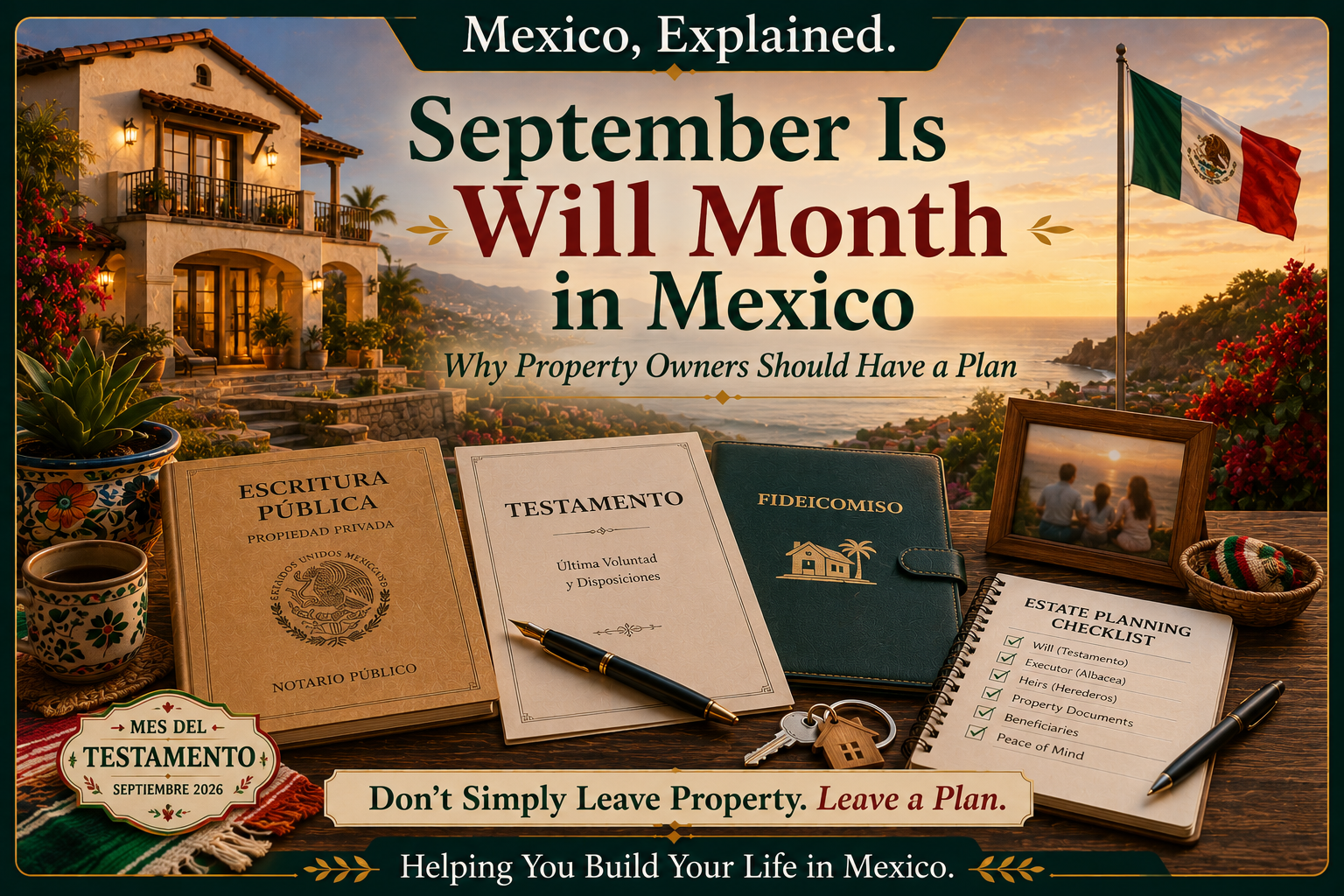
September Is Will Month in Mexico: Why Property Owners Should Have a Mexican Will
Mexico, Explained.
September Is Will Month in Mexico: Why Property Owners Should Have a Mexican Will
Protecting Your Property, Your Family and the Life You’ve Built in Mexico
By Andy & Christine | eXp Realty México
September in Mexico is a month filled with meaning.
Mexican flags appear everywhere.
Families gather.
Cities celebrate.
The country commemorates its Independence.
But September also represents something much quieter—and incredibly important for anyone who owns property or has built a life in Mexico.
September is Mes del Testamento — Will Month.
Since 2003, Mexico's Secretaría de Gobernación and the Mexican Notariat have promoted a national campaign encouraging people to prepare their wills. In 2026, Mexico celebrates the 24th edition of this initiative.
During September, participating notaries throughout Mexico offer special conditions to make preparing a will easier and more accessible.
But beyond the campaign itself lies a much bigger question:
If you own property in Mexico, what happens to it when you're gone?
It's a subject many of us prefer not to think about.
Yet preparing a will isn't really about death.
It's about making decisions while you can—so the people you care about don't have to make them for you later.
What Is a Mexican Will?
A testamento is a legal instrument in which a person establishes how their property and rights should be handled after their death.
Mexico's Secretaría de Gobernación describes a will as a personal, revocable and freely made act through which a capable person disposes of their property and rights for after death.
In practical terms, it allows you to say:
This is what I own.
These are the people I want to protect.
This is who I want to inherit.
This is who I trust to carry out my wishes.
And:
This is how I want my estate handled when I'm no longer here.
Why September?
Mexico created the national Mes del Testamento campaign to encourage estate planning and reduce the family and legal problems that can arise when someone dies without a will.
During the campaign, notaries commonly offer preferential fees, extended hours and legal guidance. Some states may also extend their campaigns beyond September.
That makes September a natural reminder:
If you've been saying “I'll take care of my will someday,” perhaps someday should become this September.
“But I Don't Have a Large Estate.”
This is one of the biggest misconceptions surrounding wills.
You don't need to be wealthy.
You don't need several houses.
You don't need millions of pesos in the bank.
If you have something—or someone—you care about, estate planning deserves consideration.
Your estate might include:
A home
Condominium
Land
Vehicle
Bank accounts
Personal possessions
Business interests
Rights under a fideicomiso
Other property and rights
PROFECO emphasizes that a will isn't only for people with large estates; its purpose is to make your wishes clear and help prevent conflicts among the people you leave behind.
Why This Matters Especially for Property Owners
Real estate is different from many personal possessions.
You can't simply hand someone the keys and say:
“The house is yours now.”
Legal ownership needs to be transferred.
Documents need to be reviewed.
The appropriate succession process needs to take place.
Taxes and expenses may need to be addressed.
And the property may involve:
An escritura pública.
Co-ownership.
A condominium regime.
A fideicomiso.
A mortgage.
A spouse or multiple owners.
Foreign beneficiaries.
Property in more than one country.
Without planning, what seemed like a simple property can become a complicated problem for the people left behind.
What Happens If You Die Without a Will in Mexico?
When someone dies without a valid will, they die intestate.
That doesn't mean their property simply disappears or automatically goes to whichever family member everyone assumes should receive it.
A succession process must determine who has the legal right to inherit.
Mexico's Secretaría de Gobernación explains that without a will, an intestate succession must be initiated and the legally entitled heirs identified. Depending on the circumstances, potential heirs can include descendants, a spouse or partner, ascendants and certain collateral relatives.
There must still be:
An estate proceeding.
Recognition of heirs.
An executor or administrator.
An inventory and valuation.
Administration of the estate.
Division and adjudication of the assets.
The important difference is that you haven't left your own instructions to guide that process.
A Will Lets You Decide
This is perhaps the simplest reason to have one.
Without a will:
The law determines who inherits according to the applicable succession rules.
With a will:
You express your wishes regarding who should receive your property and rights.
That's an enormous distinction.
A will allows you to plan instead of leaving those decisions entirely to the succession rules that apply after your death.
A Will Can Help Prevent Family Conflict
Anyone who has worked around real estate long enough eventually encounters properties where inheritance was never properly resolved.
Perhaps a parent died.
Then one of the children died.
Then another heir moved abroad.
Years pass.
Eventually someone wants to sell the house.
And suddenly there are:
Multiple potential heirs.
Missing documents.
Unresolved estates.
Different opinions.
Family disagreements.
People living in different countries.
Sometimes even multiple generations of succession issues.
The property itself may be perfectly good.
The problem is that ownership was never properly transitioned from one generation to the next.
Mexico's government specifically promotes wills as a way of reducing unnecessary legal costs, delays and family disputes.
A Will Doesn't Mean You're Giving Away Your Property Today
Some people hesitate because they think:
“If I name my children as heirs, do they become owners now?”
No.
Making a will does not mean transferring ownership of your property while you're alive.
You remain the owner.
You can continue to:
Live in the property.
Rent it.
Sell it.
Remodel it.
Mortgage it when legally possible.
Or otherwise dispose of it.
The heirs designated in a will do not become owners merely because you named them. The Mexican government's guidance specifically confirms that the testator remains free to sell, give away or otherwise deal with their assets during their lifetime.
And You Can Change Your Mind
Another important misconception:
“What if I make a will today and my circumstances change?”
A will isn't necessarily a decision frozen forever.
A Mexican testamento is revocable.
Families change.
Relationships change.
Assets change.
People buy and sell property.
Your wishes may change.
Estate planning should evolve with your life.
Do You Need to List Every Property You Own?
Not necessarily.
According to Mexico's official guidance, you generally do not need to arrive at the Notario with a complete inventory of every asset simply to make a will.
If you're naming heirs generally, you can communicate your wishes to the Notario.
However, if you want to leave a particular asset to a specific person as a legado, the asset needs to be identified appropriately.
Your Notario can explain the best structure for what you want to accomplish.
What Is an Albacea?
Another term you'll hear in Mexican estate planning is:
Albacea
This is generally the person responsible for administering the estate and helping carry out the terms of the will through the succession process.
Choosing an albacea deserves thought.
It should be someone appropriate for the responsibility—not simply the first name that comes to mind.
Your Notario can explain the role and responsibilities involved.
What If You Have Minor Children?
Estate planning becomes even more important when minor children are involved.
A will can address matters beyond simply deciding who receives a house.
Mexican consumer-finance guidance notes that parents exercising parental authority can use a will to designate a guardian (tutor) for minor children in the event both parents die.
For families, this can be one of the most important reasons to stop postponing the conversation.
What If You're a Foreigner Who Owns Property in Mexico?
This is where our Mexico, Explained. perspective becomes particularly important.
Many foreign property owners already have a will in:
Canada.
The United States.
France.
The United Kingdom.
Or another country.
And naturally they ask:
“Isn't my will back home enough?”
That's not a question we recommend answering with a generic yes or no.
Cross-border estate planning can involve:
Mexican law
Foreign law
The location of your assets
Your nationality
Residence and domicile
How the Mexican property is titled
Whether it is held through a fideicomiso
Beneficiary designations
Potential tax consequences
Whether wills in different jurisdictions coordinate with one another
This is exactly the kind of situation where professional advice matters.
A Mexican Notario and, where appropriate, a cross-border estate-planning or tax professional should review your particular circumstances.
“I Already Have a Will in Canada or the United States.”
Good.
But don't stop the analysis there.
The better question is:
“Does my existing estate plan properly address my Mexican assets?”
A foreign will may have legal effects in Mexico subject to applicable law and formalities, but using a foreign document can introduce additional procedural requirements.
Depending on the circumstances, documents may need authentication or apostille, translation by an authorized translator, recognition and other steps before they can be used effectively in Mexico.
That's why someone who owns significant assets in more than one country should seek coordinated estate-planning advice.
The objective isn't necessarily to have as many wills as possible.
It's to make sure the documents you do have work together rather than contradict one another.
What About a Fideicomiso?
This is especially relevant to foreign owners of coastal property.
If you own residential property within Mexico's restricted zone through a bank trust—or fideicomiso—your estate planning deserves additional attention.
A fideicomiso can include substitute beneficiaries who may receive the beneficial rights after the primary beneficiary's death, subject to the trust terms and applicable procedures.
That's one reason we encourage foreign buyers to think about succession when the fideicomiso is being established, rather than treating it as an afterthought.
Ask:
Who is currently listed as beneficiary?
Who are the substitute beneficiaries?
Are those designations still what I want?
Do they coordinate with my broader estate plan?
What documentation will my beneficiaries eventually need?
Don't simply assume:
“I named someone in the fideicomiso, so I don't need to think about estate planning anymore.”
The trust and your overall estate plan should be reviewed together by the appropriate professionals.
What If Your Mexican Property Is Directly Titled?
If your property is held directly through an escritura rather than a fideicomiso, succession planning is equally important.
Ask:
Who should inherit my ownership rights?
And then have the Notario explain how best to document that intention.
This can be particularly relevant for:
Mexican citizens
Foreigners owning outside the restricted zone
Naturalized Mexican citizens
Couples with different nationalities
Co-owners
Owners with children from previous relationships
The right structure depends on the person—not simply the property.
Couples Shouldn't Assume Everything Automatically Goes to the Other Spouse
This is another area where assumptions can cause problems.
Marriage doesn't mean every asset automatically passes exactly as you expect in every circumstance.
Relevant factors can include:
How the property is titled
The marital-property regime
Whether there is a will
Whether children or other heirs exist
Applicable succession law
How and when the property was acquired
Rather than relying on:
“My spouse will obviously get everything,”
ask the Notario to confirm how your actual ownership and estate plan work.
What About Property You Own With Someone Who Isn't Your Spouse?
This deserves even more attention.
Maybe you purchased a home with:
A partner.
Sibling.
Friend.
Business associate.
Or family member.
If one co-owner dies, the surviving owner shouldn't simply assume the deceased person's ownership percentage automatically becomes theirs.
The deceased owner's interest may become part of the succession.
This is exactly the type of situation that should be planned before there's a problem.
A Mexican Will Is Part of Good Property Management
We often talk about property ownership in terms of:
Maintaining the house.
Paying predial.
Keeping CFE current.
Paying HOA fees.
Maintaining the fideicomiso.
Keeping your escritura safe.
Updating construction records.
But there's another responsibility:
Planning what happens to the property after you.
If you've spent years building an asset, protecting it should include planning its eventual succession.
Keep Your Property Documents Organized Too
Making a will is an excellent opportunity to organize your entire property file.
Consider keeping together:
Escritura Pública
Fideicomiso documents, if applicable
Property-tax records
Cadastral information
CFE records
HOA information
Bank information
Insurance policies
RFC and fiscal documents
Identification
Marriage documents
Existing wills
Important professional contacts
And make sure someone you trust knows where the important documents can be found.
A beautifully prepared estate plan isn't very useful if nobody knows it exists.
What Does It Take to Make a Will in Mexico?
The process is often simpler than people expect.
Official guidance says that generally you:
Meet the minimum legal age applicable in your state.
Choose a Notario Público.
Present official identification.
Explain your wishes to the Notario.
Provide any additional information required for your circumstances.
Review and execute the document according to the applicable formalities.
Requirements can vary by state, including whether witnesses are required.
You don't need to arrive knowing how to draft legal language.
That's the Notario's job.
You need to know what you want to accomplish.
Why September 2026 Is a Particularly Good Time
This year's national Septiembre, Mes del Testamento campaign is the 24th edition of the program created through cooperation between the Secretaría de Gobernación and Mexico's Notariat.
During September 2026, notaries across Mexico are participating in the campaign, with preferential costs and many offices opening on Saturdays to make appointments easier to access.
The exact cost and conditions vary by state, so homeowners should check the current program where they live.
Official 2026 Mes del Testamento campaign
If You Own Property in Guerrero
For those of us on Mexico's Pacific Coast, it's worth watching the program announced locally for Guerrero as September approaches.
Campaign conditions and fees are established locally and can vary from year to year, so rather than assuming last year's price still applies, we recommend confirming the 2026 Guerrero campaign directly with your chosen Notario or the Colegio de Notarios.
This is particularly relevant for property owners in:
Zihuatanejo
Ixtapa
Troncones
Playa Larga
and surrounding communities.
The Cost of a Will vs. the Cost of Not Having One
It's tempting to postpone a will because:
“There's plenty of time.”
But none of us actually knows that.
The financial comparison matters too.
Preparing a relatively straightforward will while you're alive, available and able to explain exactly what you want can be far simpler than asking your family to resolve an intestate estate after your death.
The Mexican government specifically identifies avoiding greater expenses, delays and family problems as advantages of making a will.
But there's another cost that's harder to calculate:
Uncertainty.
When there's no clear plan, the people you leave behind may be forced to make important decisions while they're grieving.
A will can remove some of that uncertainty.
When Should You Review Your Will?
Making a will isn't necessarily a one-time event.
Consider reviewing your estate plan after significant life changes such as:
Marriage
Divorce
Birth or adoption of a child
Death of a beneficiary
Purchasing property
Selling property
Moving permanently to Mexico
Becoming a Mexican citizen
Establishing or modifying a fideicomiso
Significant changes in your financial situation
Changes to your relationships or wishes
Even if nothing major has changed, periodically reviewing the document makes sense.
Ask yourself:
“If this document were used tomorrow, would it still reflect what I want today?”
If the answer is no, speak with your Notario.
The Property Owner's September Checklist
September is a good time to do more than simply sign a will. Use it as an annual property and estate-planning checkup:
Review or prepare your Mexican will.
Confirm your heirs and legatees still reflect your wishes.
Review your albacea.
Check your fideicomiso and substitute beneficiaries, if applicable.
Organize your escritura and important property documents.
Review ownership percentages if the property has multiple owners.
Make sure your spouse or family knows where key documents are located.
Review your Mexican and foreign estate plans together if you own assets in multiple countries.
Update outdated identification and fiscal documentation.
Ask a Notario about anything you're assuming rather than actually knowing.
The goal isn't to make September a month about worrying about death.
It's to make it a month about planning responsibly for life.
Final Thoughts
We spend so much time planning how to acquire property.
We research neighborhoods.
Compare prices.
Negotiate offers.
Review contracts.
Arrange financing.
Establish fideicomisos.
Sign escrituras.
Renovate.
Build.
Invest.
And then, strangely, many of us never plan the final part:
What happens to everything we've built when we're no longer here?
A will is one of the simplest ways to bring intention to that question.
It's not only a legal document.
It's a set of instructions.
It's clarity.
It's preparation.
And, perhaps most importantly, it's a way of making things easier for the people you care about.
So while Mexico celebrates its history and independence this September, consider taking care of something important for your own family's future.
Don't simply leave property.
Leave a plan.
Continue Exploring Mexico, Explained.
If you own property in Mexico, you may also want to read:
Understanding Property Ownership in Mexico: A Beginner's Guide
What Is a Fideicomiso? Understanding Coastal Property Ownership in Mexico
Selling Property in Mexico? Documents You Should Prepare Before Listing
Capital Gains Tax When Selling Property in Mexico: What Sellers Need to Know
Why the Right Notary and Legal Team Matter More Than You Think
Together, these articles are designed to help property owners understand not just how to buy real estate in Mexico—but how to own, protect, sell and eventually transfer it responsibly.
Thinking About Your Property Planning in Mexico?
As real estate advisors, our role isn't to prepare wills or provide estate-planning advice.
But we strongly believe that understanding how your property fits into your broader plans is part of responsible property ownership.
A qualified Notario Público can explain the testamentary options available for your individual circumstances, and international property owners may also benefit from coordinated cross-border legal and tax advice.
Andy & Christine
eXp Realty México
Helping You Build Your Life in Mexico—One Informed Decision at a Time.
This article is for general educational purposes and is not legal, tax or estate-planning advice. Succession and testamentary rules vary according to individual circumstances and applicable state and federal law. Consult a qualified Notario Público and, where appropriate, legal and tax advisors regarding your particular situation.