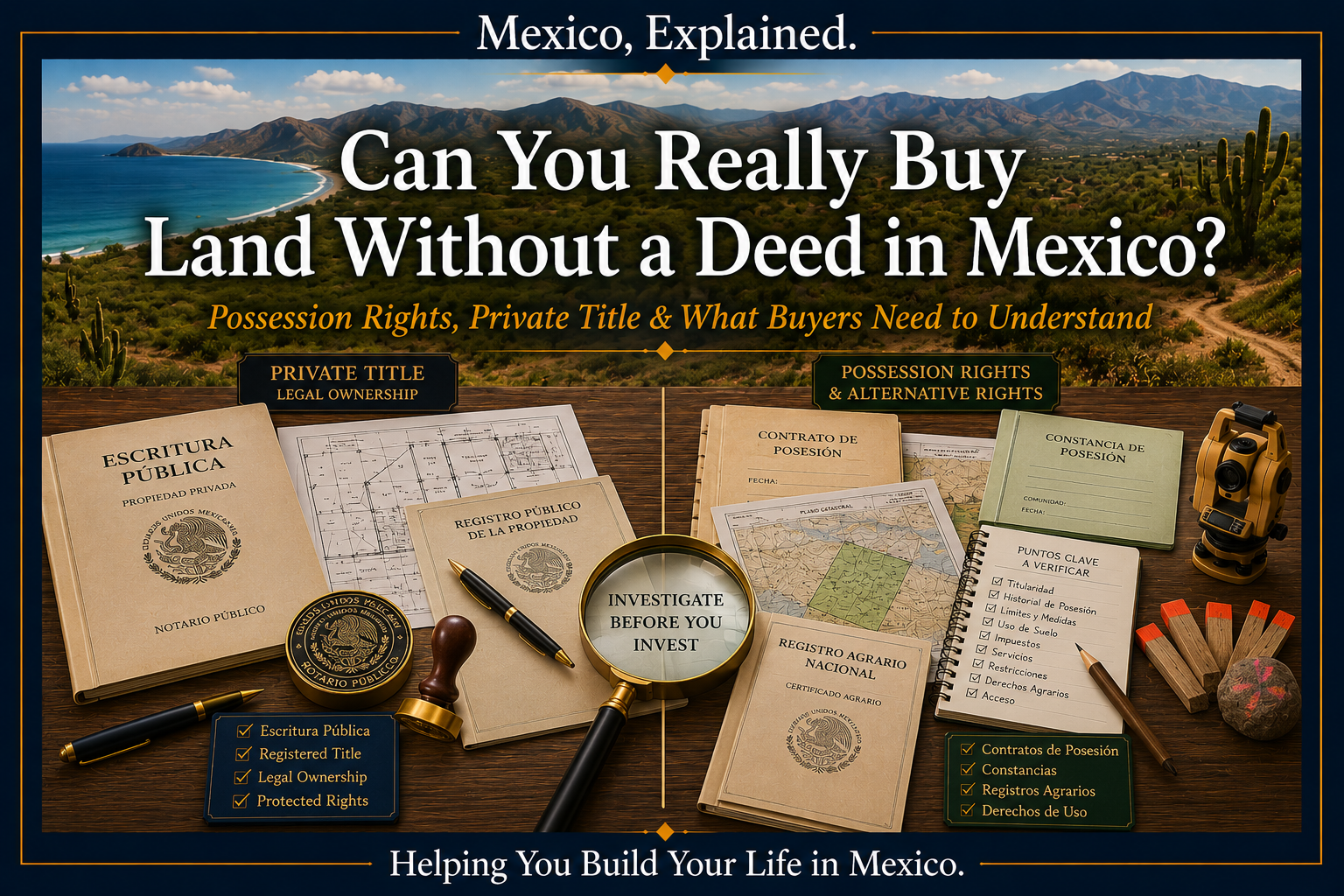
Can You Really Buy Land Without a Deed in Mexico?
Understanding Possession Rights, Private Title, Ejidos, Communal Land—and the Risks Before You Buy
By Andy & Christine | eXp Realty México
You've found a beautiful piece of land in Mexico.
The location is incredible.
The price is attractive.
Perhaps it has mountain views, sits close to the ocean, or offers enough space to build exactly what you've been dreaming about.
Then you ask for the deed.
And someone tells you:
“There isn't one—but don't worry. Everyone here buys this way.”
What does that actually mean?
Can you really buy land in Mexico without a deed?
The answer requires an important distinction.
You may be able to acquire certain rights or possession connected to land without receiving a conventional private-property deed, but that is not necessarily the same thing as purchasing privately titled real estate.
And understanding that difference is critical.
First: What Do We Mean by a “Deed”?
In Mexico, privately owned real estate is generally formalized through an escritura pública before a Mexican Notario Público and registered with the appropriate Registro Público de la Propiedad.
That escritura is much more than a piece of paper.
It forms part of the legal framework documenting ownership and the transfer of the property.
So when someone tells you:
“This property doesn't have a deed,”
your next question shouldn't automatically be:
“Is it safe?”
It should be:
“Then what legal right is actually being transferred?”
That question changes everything.
Possession Is Not Necessarily Ownership
This is perhaps the most important concept in this entire article.
Possessing land and legally owning privately titled land are not automatically the same thing.
A person may have occupied, used, cultivated, maintained, fenced, or even built on a parcel for many years.
There may also be documents supporting that possession.
But those facts alone should not automatically be interpreted as proof of private title.
The buyer needs to understand the legal nature of the seller's rights and whether those rights can legally be transferred.
What Are Possession Rights?
The word posesión appears frequently in Mexican land transactions.
But “possession rights” should never be treated as a universal type of ownership.
The underlying circumstances matter.
A seller may present documents such as:
possession certificates,
contracts,
community records,
tax receipts,
cadastral records,
surveys,
historical agreements,
or other evidence relating to use or possession.
Those documents may be relevant.
But their existence does not automatically create privately titled ownership.
This is where professional legal review becomes essential.
Private Title Is Different
A privately titled property operates under a different legal framework.
In a conventional private-property transaction, professionals can investigate matters such as:
Who owns the property
How ownership was acquired
Whether the property is registered
Whether liens or encumbrances exist
Whether the seller has authority to sell
Whether taxes are current
Whether the property's legal description corresponds with its physical boundaries
That doesn't mean privately titled property is automatically free from problems.
It still requires due diligence.
But the legal framework is different from simply acquiring possession or agrarian rights.
What About Ejido Land?
This is another area where buyers can become confused.
An ejido is a form of agrarian landholding governed by Mexican agrarian law.
An ejidatario may hold recognized rights within the ejido, including rights associated with particular parcels.
But those rights should not automatically be confused with a conventional private-property deed.
Certain ejido parcels can potentially transition into private property through procedures established under Mexican law, including dominio pleno where legally applicable.
But—and this is crucial—
Not every ejido parcel has completed that process simply because someone says it eventually can.
Buying based on the expectation of future conversion without verifying the property's present legal status can create significant risk.
And What About Bienes Comunales?
Bienes Comunales are another form of agrarian property.
As we discussed earlier in this series, they are not simply another name for ejidos.
Communal land generally involves collectively recognized rights governed by agrarian law and community structures.
The rights of an individual community member, the community's rights over the land, and the procedures governing transfers must therefore be understood before any transaction is contemplated.
Again, the key question is not:
“Can I buy communal land?”
The better question is:
“What exactly is being transferred, by whom, under what authority, and what rights will I actually receive?”
Why Is Land Without a Private Deed Sometimes So Attractive?
There is a reason buyers encounter these opportunities.
They can be incredibly appealing.
Land without conventional private title may sometimes be:
Less expensive
Located in emerging areas
Larger than nearby privately titled parcels
Situated in beautiful rural or coastal locations
Available before surrounding areas become heavily developed
And in some circumstances, legitimate opportunities may exist.
That's why simply saying “Never touch anything without a deed” can be an oversimplification.
But saying “Don't worry about the deed” is equally problematic.
The right approach is investigation.
The Price Difference Often Reflects the Difference in Risk
Imagine two similar parcels.
One has established private title and a clearly documented ownership history.
The other is being offered through possession or another type of right.
If the second property costs substantially less, buyers should ask:
Why?
The discount may reflect uncertainty, restrictions, additional procedures, reduced marketability, financing limitations, or legal risk.
A lower purchase price doesn't necessarily make something a bad opportunity.
But buyers should understand what they're receiving in exchange for accepting that additional risk.
What Are the Risks?
The risks depend entirely on the property, but potential concerns can include:
Unclear ownership or rights
The person offering the property may possess it without holding the legal authority the buyer assumes they have.
Conflicting claims
Other individuals, heirs, community members, neighbors, or rights holders may have interests affecting the land.
Boundary problems
Physical fences and informal landmarks may not correspond with legally recognized boundaries.
Difficulty reselling
A future buyer may not accept the same ownership or possession structure.
Financing limitations
Traditional mortgage financing may be unavailable for property without conventional private title.
Construction complications
Land use, zoning, permits, environmental restrictions, utilities, or other requirements may affect what can legally be built.
Regularization uncertainty
A seller may promise that obtaining private title will be easy or inevitable.
It may not be.
Never base a purchase solely on a future legal outcome that has not occurred.
“But Everyone in the Area Buys This Way”
This is one of the most common arguments buyers hear.
And it may even be true.
A particular community may have transferred possession informally for decades.
That information provides useful context.
But widespread local practice doesn't automatically answer the legal questions surrounding your particular transaction.
Ask:
Who legally holds the rights?
What rights do they hold?
Can those rights legally be transferred?
What documentation supports them?
What will I receive after paying?
Can those rights later become private property—and if so, what still needs to happen?
Those are much more useful questions.
“I've Been Paying Property Taxes, So I Own It”
Another common misconception involves predial, or local property tax.
Tax receipts can be important documentation.
But paying property taxes should not, by itself, be treated as conclusive proof of privately titled ownership.
The same principle applies to utility bills.
Having electricity or water in someone's name can demonstrate a relationship with the property.
It does not necessarily answer the legal ownership question.
“There's a Cadastral Number, So It Must Be Titled”
Not necessarily.
Cadastral records and private-property registration serve different purposes.
A property appearing in municipal cadastral records does not automatically mean it has a privately registered title.
This distinction is especially important when evaluating land.
“The Seller Says the Deed Is Coming Soon”
This statement deserves careful investigation.
Ask:
What process is underway?
Which authority is handling it?
What stage has been completed?
What documentation proves that?
What remains outstanding?
Is completion guaranteed—or merely expected?
There is an enormous difference between a legal process that is nearly complete and a verbal promise that someday something might happen.
What Should You Verify Before Considering a Purchase?
Depending on the property, professional due diligence may involve reviewing:
Seller identity
Legal nature of the seller's rights
Ownership or possession history
Agrarian records
Registro Agrario Nacional records, when applicable
Public Registry records, when applicable
Community or ejido documentation
Assembly resolutions, when relevant
Surveys and boundaries
Cadastral information
Property taxes
Land-use regulations
Environmental restrictions
Easements and access
Existing disputes or claims
Building possibilities
The legal mechanism proposed for the transfer
Not every item applies to every property.
That's exactly why every case needs to be evaluated individually.
Foreign Buyers Need an Additional Layer of Review
Foreign buyers should be particularly careful not to assume that acquiring possession rights is equivalent to purchasing a property through a fideicomiso.
They are completely different concepts.
For residential private property located within Mexico's constitutionally restricted zone, a foreign buyer may typically acquire rights through a bank trust structure when applicable.
But a fideicomiso does not magically convert uncertain land rights into private property.
The underlying legal status of the property must first be understood.
Opportunity and Risk Can Exist at the Same Time
This is perhaps the most balanced way to look at these properties.
A property can be:
beautiful,
well located,
reasonably priced,
and genuinely interesting...
while still carrying legal or practical risks that a buyer needs to understand.
Those ideas aren't contradictory.
The objective of due diligence isn't to make every unconventional property look dangerous.
Nor is it to make every opportunity look safe.
It's to replace assumptions with facts.
When Walking Away Is the Right Decision
Sometimes due diligence reveals that the uncertainty is simply greater than the buyer is comfortable accepting.
Walking away in that situation isn't a failed transaction.
It's due diligence doing exactly what it was supposed to do.
Likewise, there may be situations where the documentation, legal framework, professional advice, and buyer's objectives align sufficiently for the buyer to decide to proceed.
The important word is:
informed.
Final Thoughts
So, can you really buy land in Mexico without a deed?
The better answer is:
You may be able to acquire certain rights relating to land without receiving a conventional private-property deed—but you need to understand precisely what those rights are.
Possession isn't automatically private ownership.
An ejido right isn't automatically private title.
Communal rights aren't automatically transferable like conventional real estate.
A cadastral record isn't automatically an escritura.
And a promise of future regularization isn't the same as private title today.
That doesn't mean every unconventional land opportunity should be rejected.
It means it should be understood.
Because when buying property in Mexico, the most important question isn't simply:
“What am I paying for?”
It's:
“What exactly will I legally own or have the right to use after I pay for it?”
That is the question every buyer deserves to have answered.
Continue Exploring the Series
This article builds directly on the previous chapters of Mexico Property Ownership Explained: Ejidos vs. Bienes Comunales, How Land Becomes Private Property in Mexico, What Due Diligence Really Means When Buying Property in Mexico, Understanding the Mexican Agrarian Registry (RAN), and Why the Right Notary and Legal Team Matter More Than You Think.
Coming Next
Understanding Possession Rights in Mexico
We'll go deeper into what possession means, what it doesn't mean, what documentation may support it, and why possession and ownership should never automatically be treated as synonyms.
Thinking About Buying Land in Mexico?
Whether you're considering privately titled property, rural land, an investment opportunity, or property with an agrarian history, understanding the legal status should come before deciding whether the price represents a good opportunity.
Our role is to help buyers ask the right questions, coordinate with qualified professionals, and understand the transaction they're considering.
Andy & Christine
eXp Realty México
Helping You Build Your Life in Mexico—One Informed Decision at a Time.