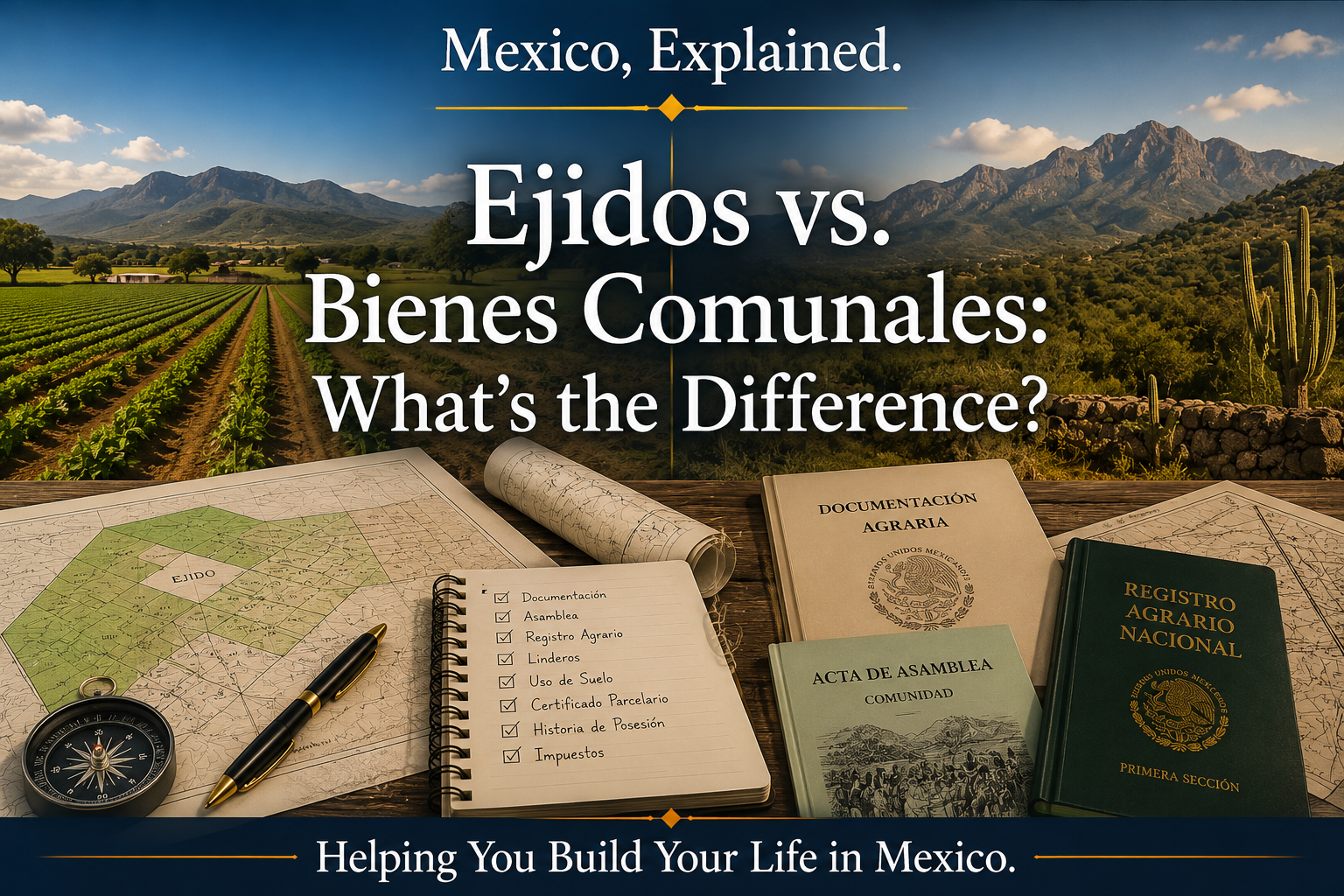
Ejidos vs. Bienes Comunales: What's the Difference?
If you've started searching for land or investment opportunities in Mexico, you've probably come across terms like Ejido or Bienes Comunales.
For many foreign buyers, those two words immediately create uncertainty.
Some assume they're exactly the same.
Others believe neither can ever be purchased.
The truth is much more nuanced.
Understanding the difference won't necessarily determine whether you should buy a property—but it will help you ask the right questions before making a decision.
Why This Matters
One of the biggest mistakes buyers make is assuming every property in Mexico follows the same ownership rules.
It doesn't.
Mexico has different forms of land ownership, each with its own legal framework and history.
Private property is only one of them.
Two of the most misunderstood are Ejidos and Bienes Comunales.
Although they share certain characteristics, they are not the same thing.
What Is an Ejido?
An Ejido is land that was granted by the Mexican government to groups of farmers following the Mexican Revolution as part of agrarian reform.
Rather than being owned by one individual, the land belongs collectively to the ejido community.
Individual members, known as ejidatarios, may have rights to use or occupy specific parcels under Mexican agrarian law.
Over time, some ejido land has legally transitioned into private property through procedures established by law.
However, not every ejido follows the same path, and every property should be evaluated individually.
What Are Bienes Comunales?
Bienes Comunales also involve collective ownership, but their origin is different.
These lands generally belong to Indigenous or traditional communities that have held and managed the land collectively for generations.
Community members exercise rights recognized under Mexican agrarian law, and decisions affecting the land are often made collectively through community assemblies.
Like ejidos, communal land follows its own legal framework, and each community may have different documentation and administrative processes.
The Biggest Difference
While both involve collective ownership, their historical origins are different.
Ejidos were primarily created through Mexico's agrarian reform during the twentieth century.
Bienes Comunales generally recognize land that Indigenous or traditional communities already occupied and managed before those reforms.
Although the legal procedures surrounding each can differ, one important principle remains the same:
Every property should be reviewed individually.
Common Misconceptions
One of the most common myths we hear is:
"Foreigners can't buy properties connected to Ejidos or Bienes Comunales."
Reality is more complex.
The answer depends on the current legal status of the property, the available documentation, and the specific transaction structure.
Another misconception is that every property associated with an ejido or communal land automatically carries the same level of risk.
That simply isn't true.
Some properties have completed legal procedures that allow private ownership, while others remain subject to agrarian regulations.
This is why assumptions should never replace proper legal review.
Documentation Is More Important Than Labels
Rather than asking:
"Is this Ejido or Bienes Comunales?"
A better question is:
"What documentation supports this property today?"
Depending on the property's legal status, documentation may include:
Agrarian Registry records
Community or ejido assembly resolutions
Survey plans
Certificates recognizing rights
Municipal documentation
Property tax records
Possession history
Other legal documents relevant to the transaction
The paperwork tells the real story.
Why Professional Guidance Matters
Buying property in Mexico is rarely about one document or one legal term.
It's about understanding the complete picture.
An experienced real estate professional, together with a qualified Mexican attorney and Notario Público, can help verify:
The property's legal status
Ownership history
Required documentation
Any restrictions that may apply
The appropriate legal process for the transaction
Education is one of the best tools a buyer can have.
Final Thoughts
Hearing the words Ejido or Bienes Comunales shouldn't automatically discourage you—or convince you to move forward without asking questions.
Instead, let those terms be the beginning of a conversation.
Mexico offers incredible real estate opportunities, but every property has its own legal story.
The more you understand that story, the more confident your investment decisions will be.
Knowledge creates confidence—and confident buyers make better decisions.
Coming Next in This Series
In the next article, we'll explore another question we hear all the time:
How Land Becomes Private Property in Mexico
Understanding that process will help you better evaluate land opportunities and recognize why every property deserves its own legal review.
Thinking About Buying Property in Mexico?
Whether you're looking for a retirement home, investment property, vacation home, or land to build your dream project, we're here to help you understand the process before you invest.
Andy & Christine
eXp Realty México
Helping You Build Your Life in Mexico—One Informed Decision at a Time.