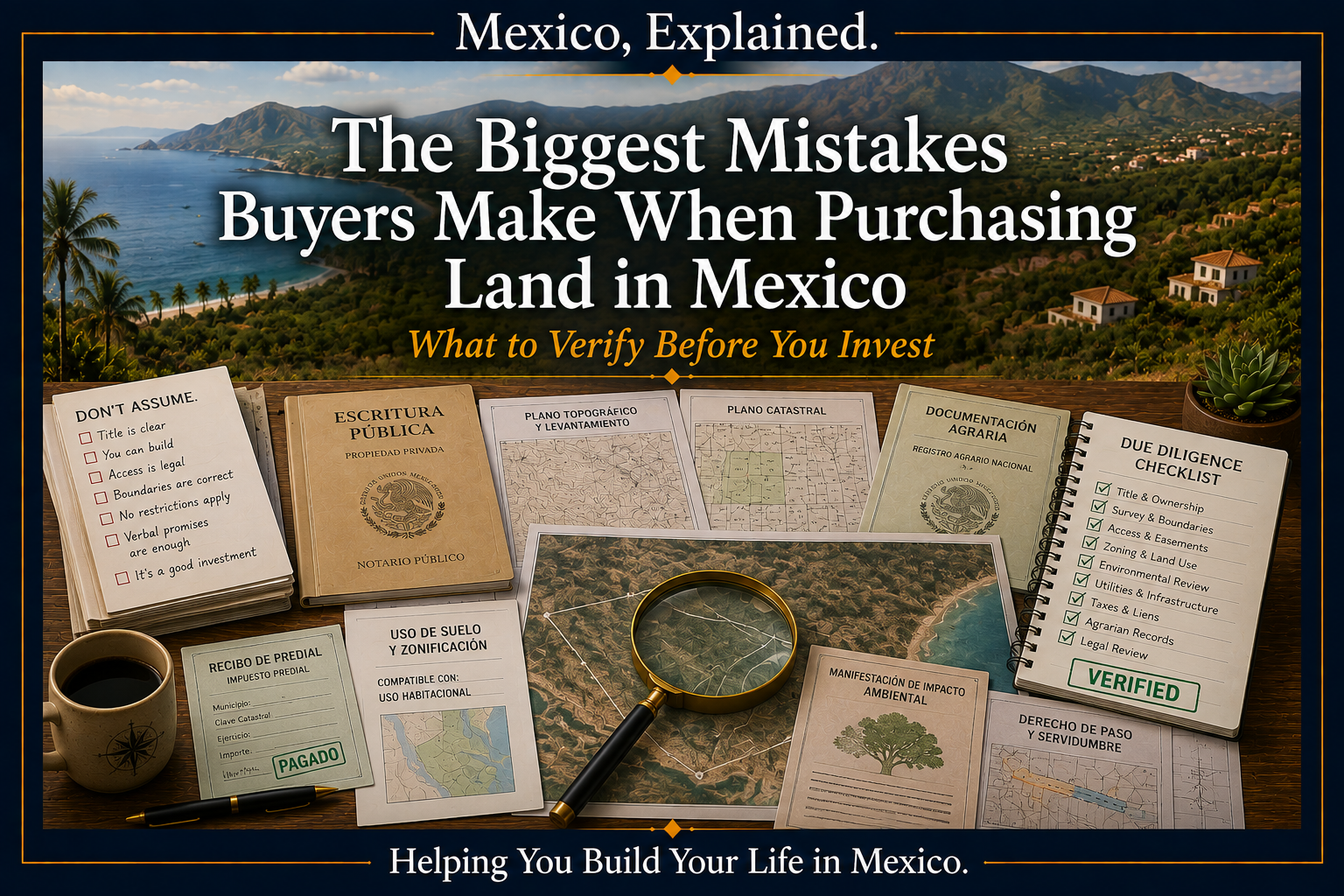
The Biggest Mistakes Buyers Make When Purchasing Land in Mexico
Beautiful Land Can Be an Incredible Opportunity—But Only When You Understand What You're Buying
By Andy & Christine | eXp Realty México
Buying land in Mexico can be exciting.
Maybe you've found a spectacular ocean-view parcel.
A tropical piece of land surrounded by nature.
A property where you can finally build your dream home.
Or several hectares offered at a price that seems almost impossible to pass up.
And that's exactly when buyers need to slow down.
Not because buying land in Mexico is inherently risky.
But because land transactions can involve questions that aren't immediately visible when you're standing on the property admiring the view.
The biggest mistakes often happen when buyers focus on what they can see—and fail to investigate what they can't.
Here are some of the most important mistakes to avoid.
Mistake #1: Buying Because It's Cheap
We've all seen those listings.
“Ocean-view land for $25,000 USD!”
And immediately, the opportunity gets your attention.
There's nothing wrong with finding a bargain.
But price should never be the primary reason to purchase land.
When a property is dramatically less expensive than comparable land nearby, ask:
Why?
The answer could be perfectly reasonable.
Perhaps the area is still developing.
Perhaps utilities haven't reached the property.
Perhaps access is difficult.
But the difference could also relate to:
Legal status
Possession rather than private title
Agrarian history
Lack of infrastructure
Zoning limitations
Environmental restrictions
Access problems
Boundary uncertainty
Difficulty obtaining construction permits
A low price isn't automatically a red flag.
But it is an invitation to investigate further.
Mistake #2: Not Asking for Documentation Before Getting Emotionally Invested
Imagine driving up a hill and discovering an incredible piece of land overlooking the Pacific.
You immediately picture your future villa.
The infinity pool.
The terrace.
Morning coffee overlooking the ocean.
It's easy to emotionally purchase the property before you've legally investigated it.
Before getting too far into the dream, ask:
“Can I see the documentation?”
Depending on the property, relevant documents might include:
Escritura Pública
Public Registry information
Cadastral documentation
Surveys
Property-tax records
Agrarian records
Possession documentation
Ejido or community documentation
Land-use information
Environmental documentation
Access rights
Building permits or previous authorizations
Not every property will have every document.
The important thing is understanding which documents should exist for that particular property.
Mistake #3: Assuming an Escritura Automatically Means Everything Is Fine
This is the opposite mistake.
Some buyers hear:
“Yes, it has an escritura.”
And stop asking questions.
Having a deed is important—but due diligence doesn't end there.
Professionals may still need to verify:
Who legally owns the property
Whether the seller has authority to sell
Whether liens or encumbrances exist
Whether the property's measurements are accurate
Whether taxes are current
Whether construction corresponds with documentation
Whether easements exist
Whether land-use restrictions apply
A deed is an important piece of the puzzle.
It isn't necessarily the entire puzzle.
Mistake #4: Relying on Verbal Promises
This is one of the biggest mistakes buyers can make.
You may hear:
“The road will be built next year.”
“Electricity is coming soon.”
“You can definitely build four villas here.”
“The title is almost ready.”
“Everyone builds here.”
“Don't worry—the land will become private property.”
Maybe every statement is true.
But before investing money based on one of those promises, ask:
Where is that documented?
A verbal promise doesn't necessarily create a legal right.
If something materially affects your decision to purchase, verify it independently.
Mistake #5: Skipping Independent Legal Review
A buyer may think:
“The seller already has a lawyer.”
Or:
“The Realtor checked everything.”
Neither should automatically replace independent professional review when it's warranted.
Your real estate advisor can coordinate the transaction, help collect documentation and identify questions.
The Notario Público performs essential legal functions in formalizing applicable real estate transfers.
But complex land transactions may also benefit from an attorney reviewing the buyer's specific interests.
This becomes particularly important when the property involves:
Possession
Ejido history
Bienes Comunales
Inheritance
Unusual ownership structures
Boundary issues
Unclear access
Regularization
Development plans
The more unusual the transaction, the more valuable specialized advice becomes.
Mistake #6: Confusing Possession With Ownership
We've dedicated an entire article to this because the distinction is so important.
Someone may have:
Occupied the property for decades
Paid predial
Installed utilities
Built structures
Maintained the land
Received a constancia de posesión
Those facts may all be relevant.
But they don't automatically establish conventional privately registered ownership.
Before purchasing possession rights, determine:
What rights does the seller actually have—and what rights can legally be transferred to me?
Never assume possession = private title.
Mistake #7: Assuming a Cadastral Number Proves Ownership
This misconception deserves special attention.
A property may appear in municipal cadastral records.
It may have a clave catastral.
Someone may even have years of predial receipts.
Those documents can be important.
But cadastral registration and private-property registration serve different legal and administrative purposes.
Don't assume one automatically proves the other.
Mistake #8: Not Verifying the Survey and Boundaries
You arrive at the property.
The seller points toward several landmarks and says:
“It goes from that tree to the road, then down to the creek.”
That may be correct.
But when purchasing land, approximate boundaries aren't enough.
A buyer should understand:
The property's legal measurements
Its total surface area
The location of boundary markers
Whether the physical parcel corresponds with the documentation
Whether neighboring properties overlap
Whether the access road crosses another property
A professional survey may reveal something that isn't obvious from standing on the land.
Mistake #9: Forgetting About Legal Access
A property can be spectacular and still have a serious problem:
How do you legally get to it?
Physical access and legal access aren't always the same thing.
Perhaps everyone has used a neighboring road for decades.
But does the property legally have the right to use it?
An established easement or right of way can be extremely important.
Never assume that because you can drive onto the property today, access will always be legally protected.
Mistake #10: Not Checking Zoning and Land Use
This is especially important for buyers planning a project.
Suppose you're purchasing land to build:
A villa
Several rental units
A boutique hotel
A restaurant
A commercial property
A residential development
Before buying, investigate whether the intended use is actually permitted.
Don't buy first and ask permission later.
A gorgeous parcel isn't necessarily suitable for every project.
Mistake #11: Ignoring Environmental Restrictions
Some of Mexico's most desirable land is desirable precisely because of its natural surroundings.
Coastlines.
Mangroves.
Jungle.
Mountains.
Wetlands.
Protected ecosystems.
But those same features can create environmental restrictions affecting development.
Depending on the location and project, federal, state or municipal regulations may apply.
A buyer planning construction should investigate environmental considerations before purchasing, not after architectural plans are finished.
Mistake #12: Assuming You Can Build Because Someone Else Did
This happens frequently.
A buyer looks next door and says:
“They built a three-story villa, so I can too.”
Not necessarily.
Their property may have:
Different zoning
Different permits
Different environmental conditions
Different legal status
Different density allowances
Different construction rights
Older approvals under different regulations
Never use neighboring construction as your only evidence of what you can build.
Verify your specific parcel.
Mistake #13: Ignoring Utilities and Infrastructure
“Utilities nearby” can mean many different things.
Before purchasing, investigate:
Electricity availability
Water source
Sewer or septic requirements
Internet availability
Road conditions
Drainage
Stormwater management
Construction access
Bringing infrastructure to undeveloped land can dramatically change the real cost of a project.
A $50,000 parcel requiring another $100,000 in infrastructure isn't really a $50,000 opportunity.
Mistake #14: Assuming Future Private Title Is Guaranteed
This is particularly important with certain possession or agrarian situations.
You may hear:
“Buy it now. We'll get the escritura later.”
Before relying on that statement, determine:
What legal process is required?
Has it started?
Which authority is involved?
What documentation exists?
What steps remain?
Who controls those steps?
Is completion legally possible?
Is there any guarantee it will happen?
Buying based on future legal status is very different from buying based on current legal status.
Understand which one you're paying for.
Mistake #15: Sending Money Before Understanding the Transaction
Exciting opportunities can create urgency.
Someone tells you:
“There are three other buyers. Send the deposit today.”
Urgency should never eliminate due diligence.
Before sending significant funds, understand:
Who receives the money
Why they're receiving it
Whether it is refundable
Under what conditions
What agreement governs the payment
What happens if due diligence reveals a problem
What happens if the transaction doesn't close
A legitimate opportunity should be able to withstand reasonable questions.
Mistake #16: Assuming Buying Land in Mexico Works Like Buying Land Back Home
This may be the biggest conceptual mistake of all.
Foreign buyers sometimes unconsciously apply the rules they're familiar with from Canada, the United States, or Europe.
Mexico has its own:
Property laws
Agrarian system
Notarial system
Registration system
Foreign ownership rules
Environmental regulations
Municipal processes
Different doesn't mean worse.
It means different.
And understanding those differences is part of being an informed international buyer.
The Opportunity Is Still Real
After reading a list like this, someone might think:
“Maybe buying land in Mexico is too complicated.”
That's not the message.
Mexico offers extraordinary opportunities.
You can find beautiful land, emerging communities, incredible locations and properties where buyers can create something truly special.
The objective isn't to eliminate excitement.
It's to combine excitement with information.
The beautiful view tells you why you want the property.
Due diligence tells you whether you understand the property.
You need both.
A Better Way to Evaluate Land
Instead of asking only:
“Is this a good price?”
Start asking:
“What exactly am I buying?”
“Who legally has the right to sell it?”
“What documentation supports that?”
“Do the physical boundaries match the documents?”
“Can I legally use the land for my intended purpose?”
“What restrictions affect it?”
“What will I legally own when the transaction is complete?”
Those questions turn an interested shopper into an informed buyer.
Final Thoughts
Some of the best real estate opportunities aren't necessarily the easiest ones.
A property may require additional research.
Documentation may need clarification.
A survey may reveal questions.
An attorney may recommend further investigation.
None of those things automatically mean you shouldn't buy.
They're simply information.
And information allows you to decide whether the opportunity matches your goals and your tolerance for risk.
The biggest mistake isn't buying an inexpensive property.
It isn't buying rural land.
It isn't even considering a property with an unusual legal history.
The biggest mistake is:
Buying something you don't fully understand.
Beautiful land deserves excitement.
Your investment deserves due diligence.
Continue Exploring the Series
This article builds on our Mexico Property Ownership Explained series, including Ejidos vs. Bienes Comunales, How Land Becomes Private Property in Mexico, What Due Diligence Really Means When Buying Property in Mexico, Understanding the Mexican Agrarian Registry, Can You Really Buy Land Without a Deed?, and Understanding Possession Rights in Mexico.
Coming Next
The Complete Guide to Buying Land in Mexico
This will bring everything together into one comprehensive resource—from identifying a property and understanding its legal status to due diligence, zoning, surveys, environmental considerations and closing.
Thinking About Buying Land in Mexico?
Whether you're considering a homesite, investment property, development opportunity, rural parcel, or land near the coast, understanding the property should come before committing to the purchase.
Our role is to help buyers ask better questions, coordinate the appropriate professionals, and make informed decisions throughout the process.
Andy & Christine
eXp Realty México
Helping You Build Your Life in Mexico—One Informed Decision at a Time.