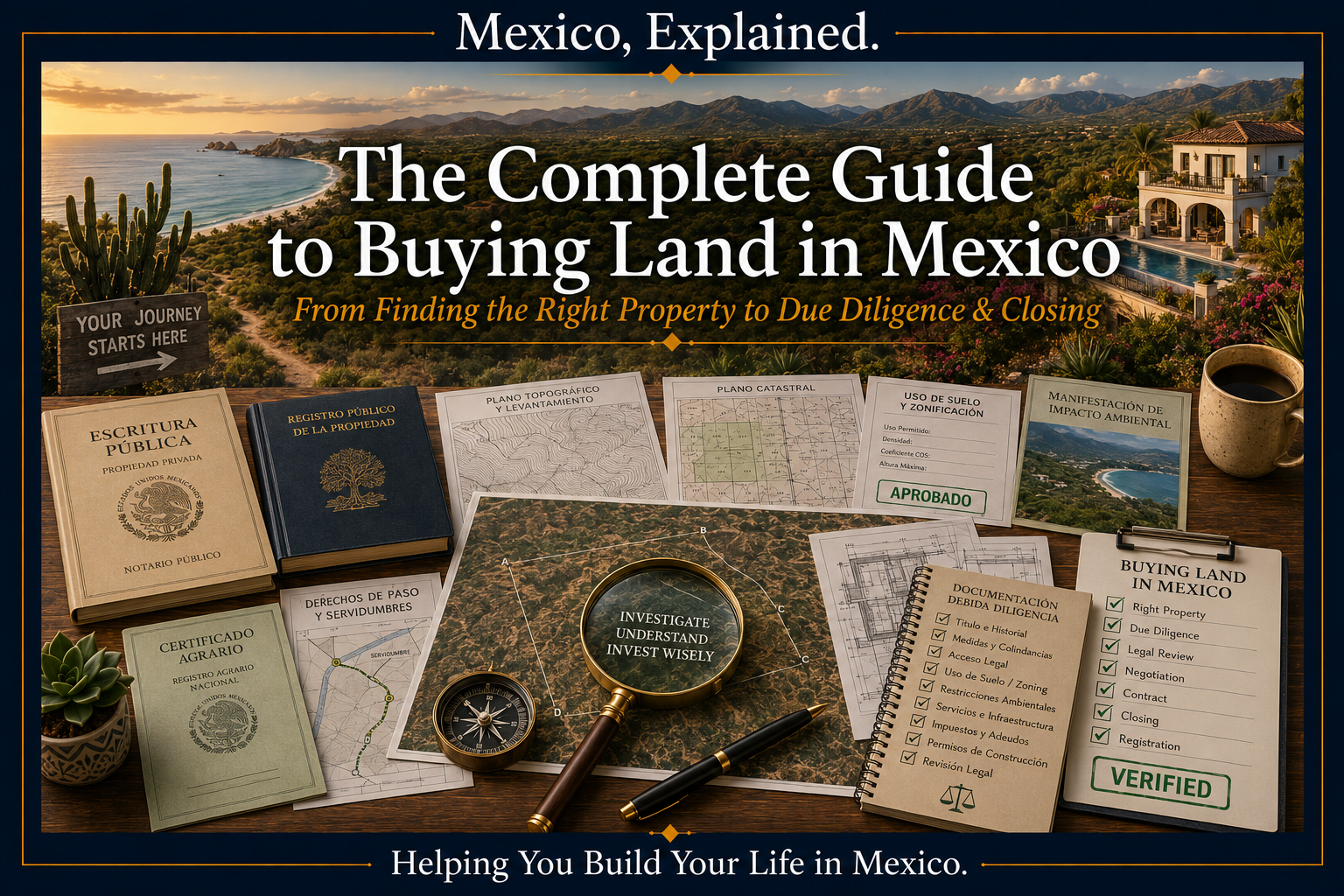
The Complete Guide to Buying Land in Mexico
From Finding the Right Property to Understanding Title, Due Diligence, Zoning and Closing
By Andy & Christine | eXp Realty México
Buying land in Mexico can open the door to something extraordinary.
A home overlooking the Pacific.
A tropical retirement property.
A small development.
An investment for the future.
Or simply a piece of Mexico you can eventually call your own.
But buying land is very different from falling in love with land.
A beautiful view can tell you why you want the property.
It can't tell you:
Who legally owns it?
What type of property is it?
Can it legally be sold?
Are the boundaries correct?
Can you build what you're imagining?
Does it have legal access?
Are there environmental restrictions?
Can a foreigner acquire it?
Those answers come from something much less glamorous than the view:
Due diligence.
This guide brings together the major concepts every buyer should understand before purchasing land in Mexico.
Step 1: Start With Your Intended Use
Before searching for land, ask yourself a deceptively simple question:
What do I actually want to do with it?
Are you planning to:
Build a private home?
Create vacation rentals?
Hold the land as a long-term investment?
Build several residences?
Develop a boutique hotel?
Operate a business?
Subdivide it eventually?
Build immediately?
Hold it for retirement?
Your intended use matters because not every parcel can legally accommodate every project.
A cheap piece of land that cannot support your intended use may ultimately be far more expensive than a higher-priced parcel that can.
Buy for your objective—not simply for the view.
Step 2: Determine What Type of Land You're Looking At
This is one of the most important steps.
Not all land in Mexico has the same legal status.
You may encounter:
Private Property
Property held under the private-property system, typically documented through an escritura pública and registered with the appropriate Public Registry.
Ejido Land
Land governed by Mexico's agrarian legal framework, where ejidatarios may hold recognized rights relating to parcels.
Bienes Comunales
Communally held agrarian land with its own historical and legal framework.
Possession-Based Situations
Properties where the seller presents evidence of possession rather than conventional registered private title.
These terms are not interchangeable.
And they shouldn't be treated as different names for essentially the same thing.
If you want a deeper explanation, start with:
Ejidos vs. Bienes Comunales: What's the Difference?
and
Understanding Possession Rights in Mexico.
Step 3: Ask for Documentation Early
One of the biggest mistakes buyers make is waiting until they've emotionally committed to a property before asking to see its documentation.
Don't be afraid to ask:
“What documents support the seller's rights to this property?”
For privately titled property, that may include an escritura and registration information.
Other land situations may involve:
Agrarian certificates
Possession documentation
Cadastral information
Surveys
Assembly records
Historical agreements
Tax receipts
Other documents supporting the claimed rights
The existence of paperwork alone isn't enough.
The important question is:
What does that paperwork legally establish?
Step 4: Verify the Seller
It sounds obvious:
Make sure the person selling the property has the legal authority to sell it.
But this can become more complicated than simply matching someone's name to a document.
The seller could be:
An individual owner
Several co-owners
Heirs
A corporation
A trustee
Someone acting through a power of attorney
A holder of agrarian rights
A possessor rather than the registered owner
The legal authority to transfer the property—or the rights being offered—should be established before the transaction moves forward.
Step 5: Understand the Ownership History
Real estate has a history.
How did the current owner acquire the property?
Was it:
Purchased?
Inherited?
Donated?
Subdivided from a larger parcel?
Regularized?
Converted from an agrarian regime?
Transferred through another legal process?
Understanding the property's history helps professionals identify questions that may require additional investigation.
A property isn't just land.
It has a legal story.
You want to understand that story before becoming part of it.
Step 6: Understand Ejidos, Bienes Comunales and Agrarian History
Agrarian land deserves special attention because international buyers frequently misunderstand it.
An ejido and Bienes Comunales are not the same thing.
Nor should agrarian rights automatically be treated as conventional private ownership.
When a property has an agrarian history, professionals may need to investigate records associated with Mexico's Registro Agrario Nacional (RAN).
That's why we created a separate guide:
Understanding the Mexican Agrarian Registry (RAN).
The objective isn't to automatically reject land with an agrarian history.
It's to determine its current legal status.
Step 7: Don't Assume Future Private Title Is Guaranteed
This deserves particular emphasis.
Buyers sometimes encounter land marketed with statements such as:
“The escritura is coming.”
“It will become private property soon.”
“Dominio pleno is in process.”
Maybe that's true.
But don't purchase based solely on the promise of a future legal status.
Ask:
What process is underway?
What steps have been completed?
What documentation confirms that?
Which authority is involved?
What remains outstanding?
Is the desired legal outcome actually available for this parcel?
Our article How Land Becomes Private Property in Mexico explores this issue in much greater detail.
Step 8: Verify the Survey and Boundaries
The seller walks the property with you and points:
“From that palm tree... over to the road... then down toward the creek.”
That's useful for getting oriented.
It's not a substitute for understanding the legal boundaries.
Depending on the transaction, a professional survey may help establish:
Surface area
Measurements
Boundary points
Neighboring parcels
Physical access
Potential overlaps
Discrepancies between documentation and reality
This becomes particularly important when buying undeveloped land.
A buyer should understand exactly where the property begins and ends.
Step 9: Verify Legal Access
There's an important difference between:
“We can drive there.”
and:
“The property has legally established access.”
A road may physically cross another person's land.
A path may have been used informally for decades.
Neighbors may currently allow access.
But what happens if the neighboring property is sold?
Access rights and easements should be investigated when relevant.
A beautiful parcel without secure legal access can create significant problems.
Step 10: Check Zoning and Land Use Before You Buy
Imagine purchasing land specifically to build four vacation villas.
Then discovering the permitted land use doesn't support your project.
This is why your intended use needs to be investigated before closing.
Depending on the location, questions may include:
Permitted use
Density
Building height
Setbacks
Construction footprint
Subdivision possibilities
Commercial activity
Vacation-rental considerations
Parking requirements
Infrastructure requirements
Don't assume that because someone built something similar nearby, you automatically can too.
Verify your property.
Step 11: Investigate Environmental Restrictions
Some of Mexico's most beautiful land is located near environmentally sensitive areas.
Coastlines.
Mangroves.
Wetlands.
Jungle.
Protected habitats.
Waterways.
Forested land.
Environmental regulations may affect what can be developed and where.
Depending on the location and proposed project, different authorities and requirements may become relevant.
Environmental due diligence should happen before you design your dream project—not after.
Step 12: Understand Water, Electricity and Infrastructure
A listing may say:
“Utilities available.”
Ask what that actually means.
Is electricity already at the property line?
How will water be supplied?
Is municipal sewer available?
Will septic infrastructure be necessary?
What about:
Road access
Drainage
Internet
Stormwater management
Construction access
Waste services
Infrastructure can dramatically affect the true cost of developing land.
A cheap parcel isn't necessarily inexpensive once development costs are included.
Step 13: Investigate Liens, Encumbrances and Other Rights
When applicable, professionals should investigate whether the property is affected by:
Mortgages
Liens
Legal claims
Easements
Restrictions
Third-party rights
Other encumbrances
This is another reason title and registry review matter.
You aren't simply investigating the owner.
You're investigating the property itself.
Step 14: Understand Property Taxes and Other Obligations
Property taxes in Mexico are commonly referred to as predial.
As part of the transaction, buyers should understand whether applicable property taxes and other obligations are current.
But remember something we discussed earlier:
A predial receipt isn't automatically proof of private ownership.
Tax documentation is one piece of the due-diligence puzzle—not the entire picture.
Step 15: Understand Foreign Ownership Rules
Foreigners can own real estate in Mexico, but how ownership is structured depends partly on where the property is located.
Mexico's Constitution establishes a restricted zone near international borders and coastlines.
For residential private property within that zone, foreign buyers commonly acquire rights through a Mexican bank trust known as a fideicomiso.
Outside the restricted zone, qualifying foreign buyers may generally acquire private property directly, subject to applicable Mexican law and formalities.
This is an area where professional guidance is essential because the correct structure depends on the property and transaction.
And remember:
A fideicomiso is an ownership structure. It does not cure an underlying title problem.
The property's legal status still needs to be established first.
Step 16: Conduct Real Due Diligence
Due diligence isn't simply collecting documents into a folder.
It's understanding what those documents mean together.
Depending on the property, review may involve:
Title
Ownership history
Seller identity and authority
Liens and encumbrances
Property taxes
Agrarian records
Surveys
Boundaries
Easements
Access
Zoning
Land use
Environmental restrictions
Utilities
Infrastructure
Existing improvements
Permits
Our complete article What Due Diligence Really Means When Buying Property in Mexico goes deeper into this process.
The central principle is simple:
Due diligence isn't looking for reasons not to buy.
It's making sure you understand exactly what you're buying.
Step 17: Build the Right Professional Team
One of the biggest mistakes foreign buyers make is searching for one person who handles everything.
Mexican real estate transactions often involve professionals with different responsibilities.
Depending on the property, your team might include:
Real Estate Advisor — Helps identify the property, negotiate terms, coordinate the transaction and keep the different parties communicating.
Notario Público — Performs essential public-law functions involved in formalizing qualifying real estate transfers.
Independent Attorney — When appropriate, provides legal advice specifically focused on your interests.
Surveyor or Technical Specialist — Verifies boundaries, measurements and technical information.
Environmental or Development Specialist — May become important when evaluating development potential.
Bank/Trustee — May participate when a fideicomiso is required.
Tax Professional — Can advise on tax consequences and ownership structures.
We've explored this in detail in:
Why the Right Notary and Legal Team Matter More Than You Think.
Step 18: Put Important Agreements in Writing
Real estate transactions generate plenty of conversations.
WhatsApp messages.
Phone calls.
Meetings.
Promises.
But important transaction terms should ultimately be documented appropriately.
That may include matters such as:
Purchase price
Deposit
Due-diligence period
Closing conditions
Property included
Payment structure
Closing date
Consequences if conditions aren't satisfied
Verbal assurances should never substitute for properly documented transaction terms.
Step 19: Understand Where Your Money Is Going
Before sending funds, know:
Who receives them
Why
Under what agreement
Whether they're refundable
Under what circumstances they're released
What happens if the transaction doesn't close
Depending on the transaction, an escrow arrangement may be appropriate.
Never allow excitement or artificial urgency to replace financial safeguards.
Step 20: Understand What Happens at Closing
Closing isn't simply the day everyone signs something.
For a conventional private-property transaction, the Notario Público plays a central role in formalizing the transfer, satisfying applicable requirements, calculating or coordinating certain taxes and fees, and facilitating registration of the transaction.
Foreign-buyer transactions may involve additional steps, including a fideicomiso where applicable.
Timelines vary.
Land transactions with unusual documentation, subdivisions, trusts, agrarian history, permits, or other complications can take longer.
The best question isn't:
“How fast can we close?”
It's:
“What needs to happen for us to close correctly?”
The Land-Buying Checklist
Before purchasing land in Mexico, you should be comfortable with the answers to these questions:
What is the property's current legal status?
Who legally owns or holds the rights being offered?
Does that person have authority to transfer them?
What documentation supports those rights?
What is the property's ownership or agrarian history?
Do the documented boundaries match the physical parcel?
Is legal access established?
Are liens, encumbrances or third-party rights present?
What zoning and land-use rules apply?
Can I legally build my intended project?
Are environmental restrictions relevant?
What utilities and infrastructure are available?
Are taxes and applicable obligations current?
What foreign-ownership structure applies?
What due diligence remains outstanding?
Who is professionally reviewing the transaction?
What exactly will I legally acquire when the transaction closes?
If you can't answer one of these questions, that doesn't automatically mean you shouldn't buy.
It means:
Keep investigating.
What About Land Without a Deed?
We've dedicated an entire article to this because the answer deserves nuance.
You may encounter situations involving possession, agrarian rights, incomplete regularization, or other legal structures.
Those opportunities shouldn't automatically be labeled good or bad.
But buyers must understand that:
Possession isn't automatically private ownership.
Agrarian rights aren't automatically an escritura.
A cadastral record isn't automatically registered private title.
Paying predial isn't automatically proof of ownership.
A promise of future title isn't the same as having title today.
Read:
Can You Really Buy Land Without a Deed in Mexico?
before evaluating this type of opportunity.
Don't Let Fear Replace Due Diligence Either
There's another side to this conversation.
Some buyers become so nervous about unfamiliar terminology that they immediately reject anything they don't understand.
That's not necessarily the answer either.
Mexico has a different legal system.
Different terminology doesn't automatically mean danger.
Agrarian history doesn't automatically mean fraud.
A complicated property isn't automatically a bad property.
The objective is neither blind confidence nor unnecessary fear.
It's informed decision-making.
The Cheapest Land May Not Be the Best Investment
Purchase price is only one part of the equation.
Consider:
Land price
Legal and closing costs
Infrastructure
Permits
Site preparation
Environmental requirements
Construction feasibility
Time
A more expensive parcel with established access, infrastructure and appropriate zoning may ultimately represent better value than inexpensive land requiring extensive work before development can even begin.
Evaluate the total opportunity, not simply the asking price.
A Beautiful View Isn't Due Diligence
This may be the most important sentence in the guide.
Standing on a piece of land can be emotional.
You imagine the house.
The pool.
The garden.
The sunsets.
That's part of what makes real estate exciting.
But before purchasing, you need to look beyond what your eyes can see.
The property's documentation, history, boundaries, access, zoning and legal status matter just as much as its view.
Maybe more.
Final Thoughts
Buying land in Mexico can be one of the most rewarding decisions you make.
It can give you the opportunity to create something uniquely yours rather than simply purchasing something someone else built.
But land requires curiosity.
Ask questions.
Request documentation.
Verify assumptions.
Understand the legal status.
Walk the boundaries.
Investigate access.
Check zoning.
Understand environmental considerations.
Build the right professional team.
And never be embarrassed to ask:
“Can you explain that to me again?”
You don't need to become an expert in Mexican real estate law to purchase property here.
You need a professional team willing to help you understand the transaction.
Because the goal isn't simply to buy land in Mexico.
It's to buy land in Mexico with confidence.
Explore the Complete Mexico Property Ownership Series
This guide brings together the concepts we've explored throughout our Mexico Property Ownership Explained series:
1. Ejidos vs. Bienes Comunales: What's the Difference?
Understand two of Mexico's most misunderstood forms of agrarian land.
2. How Land Becomes Private Property in Mexico
Explore private property, dominio pleno, and why every parcel follows its own legal history.
3. What Due Diligence Really Means When Buying Property in Mexico
Learn what should actually be investigated before you purchase.
4. Understanding the Mexican Agrarian Registry (RAN)
Discover why the Registro Agrario Nacional matters for certain properties.
5. Why the Right Notary and Legal Team Matter More Than You Think
Understand who does what during a Mexican real estate transaction.
6. Can You Really Buy Land Without a Deed in Mexico?
Explore the difference between private title, possession and other land rights.
7. Understanding Possession Rights in Mexico
Learn why possession and ownership shouldn't automatically be treated as synonyms.
8. The Biggest Mistakes Buyers Make When Purchasing Land in Mexico
Discover the assumptions that can create unnecessary risk—and how better questions can help avoid them.
Together, these articles form a roadmap for understanding how land ownership really works in Mexico.
Coming Next: The Cornerstone Guide
There's one final article I would add to complete this series:
Understanding Property Ownership in Mexico: A Beginner's Guide
Where this article is specifically about buying land, Article 10 can step back and explain the entire Mexican property-ownership landscape for someone starting from zero—including private property, condominiums, fideicomisos, the restricted zone, agrarian land, possession, deeds, registries, and the professionals involved.
That gives your blog two cornerstone resources:
“I want to understand property ownership in Mexico.”
→ Article 10
“I'm considering buying land in Mexico.”
→ This Article 9
That is a very strong internal structure for your Mexico, Explained. content.
Thinking About Buying Land in Mexico?
Whether you're considering coastal land, a homesite, an investment property, rural acreage, or a parcel for a future development, understanding what you're buying should always come before committing to the purchase.
Our role is to help you ask the right questions, coordinate the appropriate professionals, and navigate the process with greater clarity.
Andy & Christine
eXp Realty México
Helping You Build Your Life in Mexico—One Informed Decision at a Time.