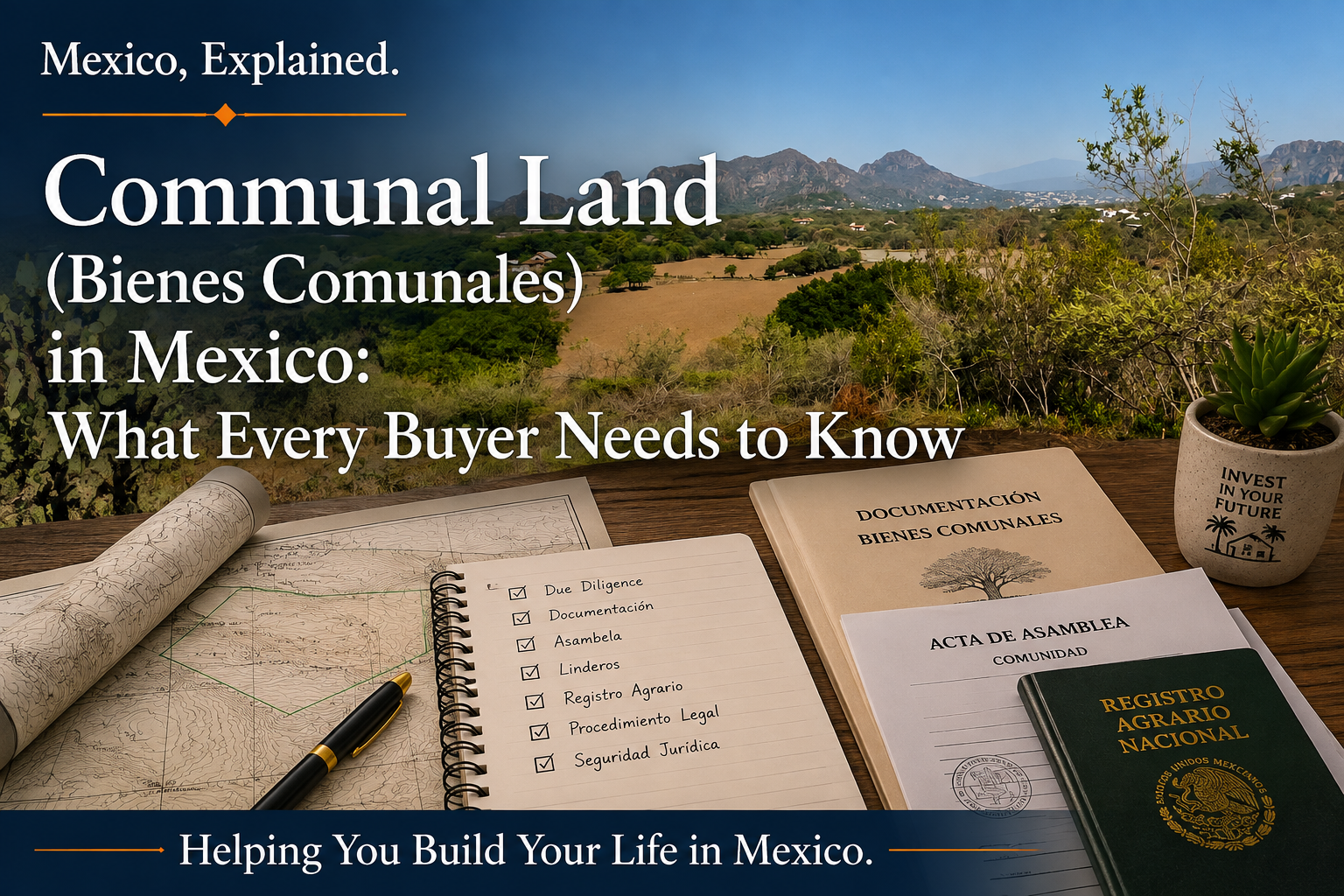
Communal Land (Bienes Comunales) in Mexico: What Every Buyer Needs to Know Before Purchasing
Mexico Property Ownership Explained
A Special Series from Mexico, Explained.
One of the questions we hear most often from buyers interested in Mexico's Pacific Coast is:
"The property says it's communal land... should I be worried?"
For many buyers—especially Canadians, Americans, and Europeans—the words Bienes Comunales immediately raise red flags.
Some stop considering the property altogether.
Others assume it's illegal or impossible to buy.
The truth is much more nuanced.
Like many aspects of Mexican real estate, communal land isn't necessarily good or bad—it simply follows a different legal framework than private property.
Understanding the difference could save you from walking away from an incredible opportunity—or from making a costly mistake.
First, What Are Bienes Comunales?
Communal land is property owned collectively by a legally recognized indigenous or traditional community.
Instead of belonging to one individual owner, the land belongs to the community as a whole.
Community members hold rights of use and occupation according to Mexican agrarian law.
This system has existed for generations and continues to protect many rural and coastal communities throughout Mexico.
Why Buyers Get Nervous
The biggest problem isn't the land itself.
It's uncertainty.
When buyers don't understand something, they naturally assume the worst.
Questions immediately arise:
Can I legally buy it?
Will I receive a deed?
Can I sell it later?
Will a bank finance it?
Can foreigners own it?
Is it risky?
These are all valid questions.
The good news is that every property has its own legal history, and those questions can usually be answered through proper due diligence.
Not All Communal Properties Are the Same
This is one of the biggest misconceptions.
Many people think every communal property follows the same rules.
That isn't true.
Some properties have already completed legal procedures allowing private ownership.
Others remain under communal status.
Some may qualify for regularization.
Others may not.
That's why no property should ever be judged solely by hearing the words "Bienes Comunales."
Every case deserves individual legal review.
The Most Important Thing Is Documentation
Rather than asking:
"Is this communal land?"
A better question is:
"What documentation supports this property?"
Depending on the property, important documents may include:
Community assembly resolutions
Certificates recognizing possession rights
Agrarian Registry documentation
Surveys and boundary plans
Municipal records
Tax receipts
Possession history
Legal opinions from qualified professionals
Every transaction is unique.
The documentation tells the story.
How Is Ownership Transferred?
Unlike a traditional private property sale, transferring communal land rights may involve additional legal procedures depending on the property's status.
Those procedures can include approvals by community authorities, agrarian documentation, or other legal requirements established under Mexican law.
Because every community operates differently, there is no universal process.
This is exactly why experienced legal guidance is essential before signing any agreement.
Can Foreigners Buy Communal Land?
This is another common misconception.
The answer depends entirely on the legal status of the property and the transaction structure.
Foreign buyers should never rely on verbal explanations alone.
Instead, they should always obtain legal advice from professionals familiar with Mexican real estate law and agrarian regulations before moving forward.
Due Diligence Changes Everything
At eXp Realty México, we believe education creates confident buyers.
When evaluating any property—whether it's private property, condominium, ejido, or communal land—we recommend completing a thorough due diligence process before committing to purchase.
This includes verifying:
Ownership history
Legal status
Available documentation
Existing restrictions
Transfer procedure
Tax implications
Notarial requirements
Any additional approvals required
The goal isn't to eliminate every risk.
The goal is to understand exactly what you're buying.
Don't Let One Phrase Make the Decision for You
Some buyers automatically reject any property labeled "Bienes Comunales."
Others buy without asking enough questions.
Neither approach is ideal.
Instead, ask questions.
Request documentation.
Work with qualified professionals.
Understand the legal process.
An informed decision is always better than one based on assumptions.
Final Thoughts
Mexico offers extraordinary real estate opportunities, but every property has its own legal story.
Communal land isn't automatically a bad investment.
Nor is it automatically the right investment.
What matters most is understanding the property's legal status, reviewing the documentation, and following the correct process with experienced professionals.
Knowledge creates confidence—and confident buyers make better decisions.
Thinking About Buying Property in Mexico?
Whether you're considering beachfront property, retirement, investment, or relocation, we're happy to help you understand the process before you make one of life's biggest decisions.
Andy & Christine
eXp Realty México
Helping You Build Your Life in Mexico—One Informed Decision at a Time.